By vapeshoppointofsale March 31, 2026
If you sell age-restricted products, a generic register is not enough. A vape shop checkout has to do more than ring up items and print receipts. It has to help prevent restricted sales, guide staff through consistent verification steps, and create a record of what happened during the transaction.
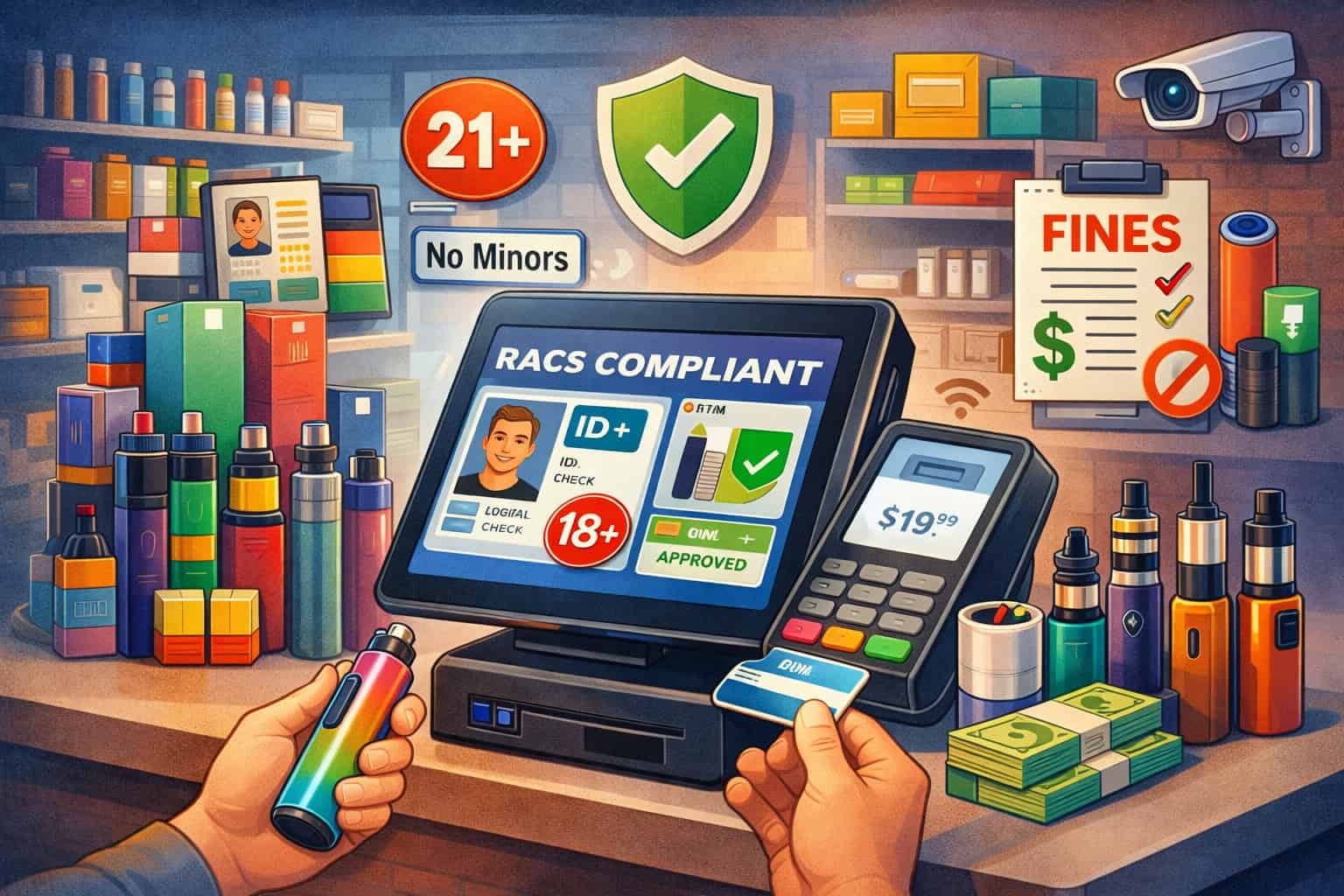
That is where RACS compliant POS systems come in. Instead of leaving critical compliance decisions to cashier memory, a RACS-style setup uses technology to control the sale from scan to payment. It is built around automated ID verification, transaction enforcement, product-level restrictions, and purchase-limit controls that reduce risk at the counter.
In practical terms, a RACS compliant POS system should require a valid government ID scan for restricted product sales, block manual workarounds when a sale should not proceed, and enforce supported product-sale rules through the transaction workflow.
That makes it very different from a basic vape register with a simple age prompt that a cashier can click past.
For vape retailers, that difference matters. A loose checkout process can create inconsistent age checks, missed prompts, weak documentation, and avoidable exposure during inspections, audits, or internal reviews. A compliance-focused system helps turn policy into a repeatable process.
This guide explains what RACS means in real retail terms, how vape shop POS systems with age verification work, what features matter most, and how to choose a setup that supports safer, more consistent operations every day.
What RACS Means in Practical Retail Terms

RACS stands for a standards-based retail control approach designed for age-restricted sales. In everyday store operations, that means the point of sale does not merely remind a cashier to check ID. It actively controls whether the sale can continue.
A traditional checkout often relies on human judgment at the moment of sale. The cashier looks at the customer, glances at a date on the ID, and then decides whether to proceed. That might seem fast, but it leaves room for inconsistency, distraction, rushed decisions, and uneven enforcement across shifts.
A retail access control standards (RACS) POS setup is different because it treats compliance as part of the transaction logic. The system recognizes when a restricted SKU is scanned. It then requires the next step in the workflow, such as government ID scanning, before the sale can move forward.
If the ID fails, the system stops the sale. If the product quantity exceeds the configured rule, the system stops the sale. If the workflow requires a scan, the cashier is not supposed to bypass it with a casual click.
That is the practical value of RACS for vape retail. It creates a controlled sequence:
- Restricted item is scanned
- Checkout triggers age verification
- Government ID is scanned and validated
- Product rules are checked
- Transaction continues only if all required conditions are met
This matters because vape compliance is rarely about one single action. It is about repeatable store behavior. When owners think about RACS compliance requirements for vape retailers, the most helpful way to understand them is not as abstract standards, but as checkout controls that make compliant behavior the default.
Why standards-based checkout controls matter in real stores
A busy store can move fast, especially during rush periods when customers are lined up and staff are juggling multiple tasks. In that kind of environment, “remember to check every ID” is not a system. It is a hope.
Standards-based controls help because they reduce dependence on memory. The register identifies the product category, triggers the right prompt, demands the right input, and records the action. That lowers the chance that one employee is strict, another is inconsistent, and a third simply skips steps when the line gets long.
For owners, this improves more than compliance. It also improves management. You get cleaner workflows, stronger accountability, more reliable training, and better reporting. Instead of asking, “Did my cashier check the ID?” you can ask, “What does the system log show for that transaction?”
RACS as a workflow, not just a feature label
Many owners hear the word RACS and assume it is one specific button, module, or certification badge. In reality, it is better understood as a workflow model for restricted retail sales.
That workflow model usually includes automatic age verification, restricted SKU recognition, transaction lockout when rules are not met, limited or no manual override, and documentation through audit logs and reporting.
That is why the term has become important in conversations about compliant vape retail POS software. It points to a system design philosophy, not just a marketing phrase.
A vape retailer should think of RACS as a checkout discipline built into technology. The system should help ensure that employees follow the same compliance path every time a controlled product is sold. That kind of structure matters whether you run one store or several locations.
When evaluating options, do not ask only whether the system “supports compliance.” Ask how the workflow actually behaves when a cashier scans a restricted product, what happens when the ID is invalid, and whether anyone at the register can override the result. Those questions get you much closer to the truth.
What a RACS Compliant POS System Actually Does
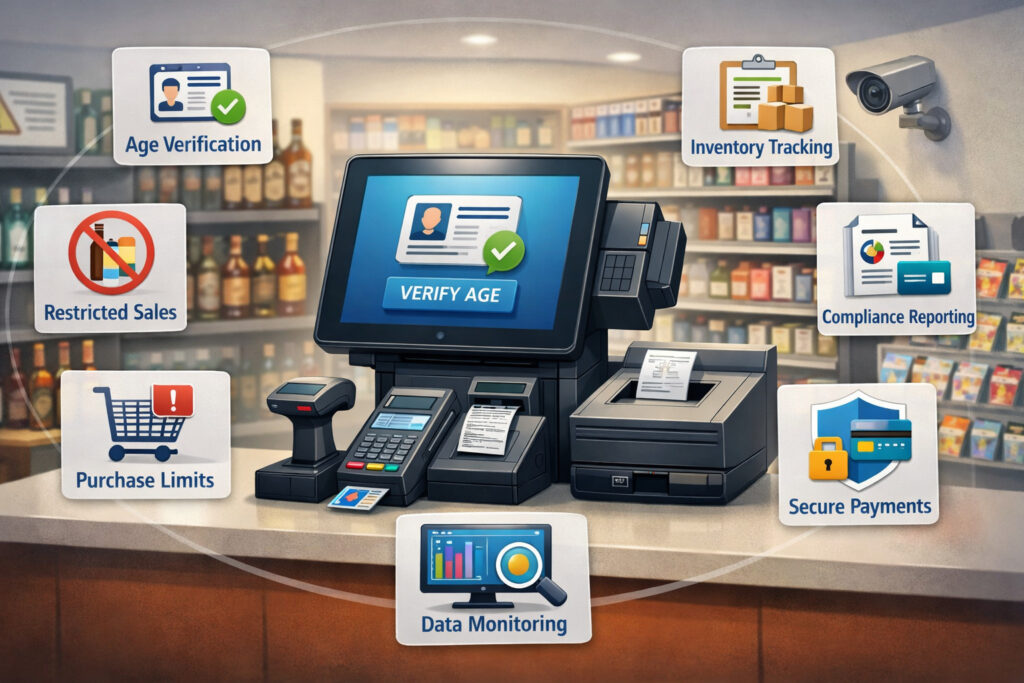
A RACS compliant POS system is a retail system designed to enforce age-restricted product sale rules automatically during checkout. The important word is enforce. Many POS platforms can display an age reminder. Far fewer can lock the transaction behind required compliance steps.
In a vape environment, that enforcement usually starts with SKU-level intelligence. The system knows which products are restricted and which rules apply to them. When one of those products is scanned, the checkout changes behavior immediately. The cashier cannot simply continue as though they are selling a bottle of water or a phone charger.
A compliance-focused POS may require a government ID scan, validate the age from the barcode or encoded data, flag expiration problems, apply quantity limits, and prevent completion if any part of the transaction fails the configured rules.
This is why owners searching for POS systems for vape shops compliance should look beyond broad retail software claims. The details of the actual transaction flow matter much more than the sales brochure.
In effect, the system becomes a control point between product access and payment. That is the central difference between a basic register and a compliance-driven register.
| Feature | Basic Vape POS | RACS-Compliant POS |
| Restricted SKU recognition | May rely on tags or manual setup | Built into product rules and checkout logic |
| Age verification | Often a reminder prompt | Required step in the transaction |
| Government ID scanning | Optional or absent | Central to the workflow |
| Manual override | Often allowed | Limited or blocked for protected actions |
| Purchase-limit enforcement | Usually manual | Automated by product rules |
| Audit trail | Basic transaction history | Detailed logs of scans, prompts, actions, and exceptions |
| Employee permissions | General role settings | Granular controls for restricted sales actions |
| Compliance reporting | Minimal | Exportable, reviewable compliance records |
The three core pillars: verification, enforcement, and documentation
A strong age verification POS for vape stores stands on three pillars. First is verification. The system must reliably identify whether the customer meets age requirements based on a valid ID process. Second is enforcement.
It must stop the sale when the rules are not met. Third is documentation. It must create records that show what happened and when.
If one of those pillars is weak, the whole compliance process becomes weaker. Verification without enforcement means an employee may still push through a sale. Enforcement without documentation makes it harder to prove your process is working. Documentation without strong verification is just a neat record of a poor control system.
When owners evaluate FDA compliant POS for vape businesses or other regulatory-friendly options, these three pillars provide a much better filter than surface-level promises. The real question is whether the system helps you verify, enforce, and document each controlled sale in a consistent way.
Why “compliance-capable” is not the same as “compliance-focused”
Plenty of retail systems advertise features such as custom prompts, pop-up warnings, or manager approvals. Those tools can be useful, but they are not the same as a true compliance-focused workflow.
A compliance-capable system may let you build your own rules if you invest time in setup, workarounds, and training. A compliance-focused system is designed from the start to handle age-restricted product controls. That usually means faster implementation, fewer gaps, and stronger consistency between locations.
For vape retail, this difference matters because restricted products create zero-room-for-sloppiness moments at the register. If the system depends too heavily on staff interpretation, your compliance outcome depends on who is on shift. That is risky.
Why RACS Matters for Vape Retailers
Vape retail operates under constant scrutiny because the products are age-restricted, product rules may change, and store-level consistency matters. That makes checkout one of the most sensitive parts of the business. One weak moment at the register can create risk that is far larger than the dollar value of the sale.
RACS-style controls matter because they shift the burden away from memory-based compliance and toward system-based compliance.
That helps owners reduce cashier error, tighten policy enforcement, and create a more defensible operating process. A store that depends on manual ID checks alone is more exposed to rushed decisions, inconsistent staff habits, and gaps in documentation.
This is why RACS compliance requirements for vape retailers are so relevant even for owners who think their team is experienced. Experience helps, but experience is not a substitute for a controlled transaction workflow. Good employees still make mistakes. Busy stores still create distractions. Manual checks still vary by person.
A vape shop POS system with age verification feature set becomes more valuable when you think in terms of repeated daily transactions. Even small error rates can add up over time. A system that reduces those errors at scale can protect margins, improve consistency, and lower stress for managers.
The risk of relying on cashier judgment alone
Manual age checks sound straightforward, but they break down in real-world retail conditions. A cashier may misread a date, accept a damaged ID without proper review, rush through a line, or make an exception for a regular customer. None of those situations require bad intent. They only require one hurried moment.
When a POS system handles barcode ID verification and controls the workflow, it reduces the number of judgment calls made under pressure. The employee still plays an important role, but the system does more of the heavy lifting. It prompts the step, reads the data, and either allows the transaction to continue or stops it.
That structure matters even more in stores with turnover, part-time workers, or multiple locations. Consistency is much harder when each employee has their own approach. Standardized checkout controls help make store policy visible and repeatable.
RACS-style controls support broader compliance operations
A vape retailer’s compliance process does not begin and end at age verification. It also includes product restrictions, employee permissions, reporting, documentation, and internal review. RACS-style controls fit into that bigger picture because they create a reliable frontline process at the counter.
For example, when your POS uses restricted product sales workflow controls, it helps connect the product file, cashier permissions, and audit logs into one system. That means you can review not only what sold, but how it sold. You can look for failed scans, repeated exceptions, void patterns, and employee behavior trends.
This is why vape POS compliance tools are often worth far more than their monthly software line item suggests. They can reduce preventable problems, simplify training, and support cleaner store operations across shifts and locations.
For many owners, the best way to understand the value is to compare the cost of stronger checkout controls with the cost of compliance mistakes, operational inconsistency, and manual oversight.
How Automated Age Verification Works at Checkout
Automated age verification is the heart of a vape shop POS systems with age verification workflow. It changes the checkout process from “cashier remembers to ask for ID” to “system requires ID handling before the sale can continue.”
The process usually begins when the cashier scans a restricted SKU. That product flag tells the POS to switch into a controlled sale mode. At that point, the screen prompts for age verification. In a stronger system, the cashier cannot skip to payment until the required step is completed.
The customer then presents a government-issued ID. Using a compatible scanner, the system reads encoded information from the ID, often from a barcode.
The POS extracts relevant data such as date of birth and, in some setups, whether the ID is expired. The software then applies the store’s compliance rules. If the customer qualifies, the transaction proceeds. If not, the system blocks the sale.
This is why ID scanning POS for vape compliance matters so much. It is not just about speed. It is about replacing guesswork with a consistent, system-driven check that reduces errors and supports a repeatable policy.
What government ID scanning actually reads
Government ID scanning is often misunderstood. The scanner is not “thinking” on its own. It is reading structured data stored in the barcode or magnetic information on the ID, then passing that data to the POS for interpretation.
In a well-configured checkout flow, the POS uses that data to verify age and detect obvious issues such as expiration. This is often faster and more accurate than having an employee manually calculate age or visually inspect dates under pressure. It also gives the system something concrete to log.
That said, scanning should not replace all cashier awareness. Staff still need to be trained to look for signs of tampering, damage, mismatch, or suspicious presentation. The best government ID scanning process combines system automation with trained human observation.
Why scan-based verification lowers cashier error
When a store relies on manual checks, the cashier has to inspect the ID, interpret the birth date, decide whether the ID is acceptable, and move the line forward. That is a lot to ask in a fast-paced retail setting.
Scan-based systems reduce that burden. The register reads the data quickly, applies the rule consistently, and records that the step happened. That lowers the chance that the cashier forgets, guesses, or miscalculates under pressure.
This is one reason age verification POS for vape stores can improve both compliance and customer flow. The transaction becomes more standardized. Staff spend less mental energy on manual calculation and more on following a clear procedure. Over time, that makes the entire checkout experience more predictable.
For owners, the benefit is simple: fewer avoidable mistakes, fewer arguments over whether the check happened, and better records when reviewing sales activity later.
Why Non-Override Checkout Controls Matter
One of the biggest differences between a basic system and a true RACS compliant POS system is how it handles overrides. In a weak setup, the register may show a prompt, but the cashier can bypass it. In a stronger setup, the POS controls the transaction path and prevents completion unless required conditions are met.
That is critical in regulated retail. If an employee can easily override an ID failure, skip a scan, or push through a restricted sale after a warning, the system is not really enforcing policy. It is only displaying it.
A no manual override compliance approach matters because it creates reliable boundaries. The employee cannot turn a prohibited sale into an approved sale through convenience, speed, or poor judgment. The transaction either meets the rules or it stops. That is exactly how a compliance system should behave when restricted items are involved.
For vape owners, this kind of transaction lockout creates operational discipline. It reduces exceptions, protects staff from pressure, and gives managers greater confidence that store policies are actually being followed at the counter.
Why overrides create hidden compliance weakness
Store owners often like the idea of flexibility. But in age-restricted retail, too much flexibility at checkout can become a liability. An override may seem harmless when used rarely, yet it creates a habit path for staff. Once employees know the system can be bypassed, the checkout rule starts to feel optional.
This is why transaction lockout matters. The best systems do not ask employees to make repeated compliance judgment calls when the software already knows the correct next step. They require the process to be completed before the sale can proceed.
If manager-level overrides exist, they should be extremely limited, fully logged, and tied to narrowly defined situations. Otherwise, the store ends up replacing one weak point with another.
How non-override rules help staff as well as owners
Strict controls are not just for management. They also help frontline employees. When the register enforces the rule, the cashier is not left in the position of negotiating with the customer about whether an exception can be made.
That matters more than many owners realize. Staff often face pressure from impatient customers, familiar faces, or people who insist they were allowed last time. A controlled POS gives employees a simple answer: the register will not allow the sale without the required step.
This improves consistency and lowers stress. It also reduces the chance that one employee becomes known as the easy person to push. A well-designed regulated retail POS controls framework protects the business, but it also supports the people working the counter every day.
How Product Purchase Limits Can Be Enforced Through POS Workflows
Purchase limits are another major area where compliance-focused software outperforms manual checkout. In a loose system, quantity rules are often communicated through training or signage. In practice, that means the cashier has to remember them, notice them, and apply them correctly under pressure.
A better approach is to build the rule into the POS itself. When the product is scanned, the system tracks the quantity in the basket and compares it against configured limits. If the shopper exceeds the allowed threshold, the sale cannot continue unless the basket is adjusted in a way that meets the rule.
This is one of the clearest examples of why compliant vape retail POS software matters. Quantity limits sound simple, but they can become inconsistent very quickly if they are left to memory. System-based enforcement removes guesswork and makes the rule visible at the moment it matters most.
For vape owners, quantity limits at checkout also help with internal consistency. One store, one cashier, and one shift should not apply a different standard than another. The POS becomes the rulekeeper.
How limit rules work in real transaction flows
In practice, quantity limit workflows can be set at the SKU level, product family level, or category level depending on the software. For example, the system may limit how many units of a certain restricted product can be sold in one transaction. The rule can trigger as soon as the item count crosses the threshold.
A strong workflow does not wait until payment. It alerts the cashier while the basket is still being built. That gives staff a clear path: explain the limit, remove the excess items, and proceed only when the basket complies.
This matters because delayed enforcement can create friction. If the customer gets all the way to the payment screen before a cashier realizes the basket breaks the rule, the interaction becomes harder to manage. Good POS design surfaces the issue early and clearly.
Why automated limits are better than verbal policy
Many stores assume a posted rule or a staff instruction is enough. But verbal policy is inconsistent by nature. Some employees will be cautious, others will be lax, and some will simply forget.
Automated limits create a much cleaner process. The register knows the rule and applies it every time. That reduces favoritism, removes ambiguity, and gives the store a consistent explanation when customers ask why the sale cannot proceed as requested.
This is especially important for multi-location operators. If quantity rules are handled manually, each location may drift into its own habits. A centralized POS rule set prevents that drift and supports more dependable compliance across the business.
The Features Vape Shop Owners Should Look For
Not every compliance claim means the same thing. Owners choosing among POS systems for vape shops compliance should focus on concrete checkout behavior, not generic feature lists. The best questions are practical ones: What does the system require? What does it block? What does it record? What can staff override? What can managers review later?
A strong compliance-ready setup usually includes restricted SKU tagging, automated age prompts, government ID scanning, barcode ID verification, lockout rules, quantity controls, employee permissions, audit logging, reporting, and alerting. But it is not enough for those features to exist somewhere in the system. They need to work together in the transaction flow.
The other major consideration is usability. A POS can be full of compliance tools and still fail in real life if the workflow is confusing, slow, or easy to misuse. Vape retailers need a system that is both strict and practical.
If you want a broader look at operational fit beyond compliance alone, this guide on how a vape shop POS can simplify store management gives helpful context around inventory, staff workflows, and register setup.
Key compliance features to prioritize first
Start with the features that most directly affect the sale itself:
- Restricted SKU controls
- Mandatory age-verification prompts
- Government ID scanning
- Barcode ID verification
- Transaction lockout for failed checks
- Quantity-limit enforcement
- Detailed audit logs
- Role-based employee permissions
- Exception alerts and manager review tools
- Compliance reporting exports
These features create the backbone of vape POS compliance tools. Without them, the store ends up depending too heavily on manual processes. That may look workable in a demo, but it usually weakens under real-world transaction volume.
Secondary features that strengthen daily operations
Beyond direct compliance controls, several secondary features can make a big difference. These include multi-location rule management, offline safeguards, receipt-level flags, training modes, dashboard alerts, and easy exception review.
For example, a store with high SKU volume may benefit from better product categorization and search controls so cashiers do not accidentally select the wrong item. A multi-store operator may need centralized policy settings so age-restricted product rules stay aligned across locations.
A cloud-based system can also help owners monitor activity remotely. If that is part of your decision, this overview of cloud vs. local POS systems for vape retailers is worth reading before you choose a platform architecture.
Basic Vape POS vs. Compliance-Focused POS
A basic vape POS usually handles the essentials of retail: product lookup, pricing, inventory counts, discounts, payments, and receipts. Some also include age reminders, inventory categories, or manager approval flows. Those tools can support operations, but they do not automatically create a compliance-safe checkout.
A compliance-focused POS is built around control logic. It knows when a regulated SKU enters the sale. It triggers required steps. It uses cashier age verification prompts as part of a process rather than as a courtesy message. It blocks the sale when the required conditions are not met. It records what happened for later review.
This distinction matters because many owners assume that a vape-specific POS must also be compliance-strong by default. That is not always true. Some systems are vape-friendly in terms of inventory and accessories, but still weak when it comes to transaction enforcement.
The best way to evaluate the difference is to watch a full checkout sequence, including failure paths. If the system only looks good when everything goes right, it may not be strong enough for real-world compliance needs.
What a basic system often does well
Basic systems often do a good job with SKU-heavy catalogs, variant inventory, promotions, and customer lookup. That makes them appealing to vape retailers, especially those focused on speed, loyalty programs, and daily store management.
They may also support barcode scanning, hardware integrations, and user permissions at a general level. For some businesses, that is enough to run operations smoothly. The problem is that smooth operations are not the same as controlled compliance operations.
A store can have good inventory and still have weak age verification. It can have fast checkout and still allow risky manual overrides. Owners should separate operational convenience from compliance strength when making decisions.
What a compliance-focused system adds
A compliance-focused system adds structure where it matters most. It links restricted products to required actions. It reduces discretion at the point of sale. It creates better auditability. And it makes the register behave like an enforcement tool, not just a recordkeeping device.
That is what owners mean when they talk about retail compliance reporting, protected transaction flows, and consistent restricted-item handling. A compliance-ready system can help the store move from reactive management to preventative management. Instead of discovering problems after the fact, it helps prevent them in the first place.
For many operators, that difference justifies the added investment. If you are evaluating budget alongside functionality, this article on understanding vape shop POS costs and long-term value can help frame the decision.
RACS Compliance Requirements for Vape Retailers Explained Simply
When owners hear “requirements,” it can sound legalistic or technical. But in practical retail terms, the main RACS compliance requirements for vape retailers can be simplified into a few core questions: Does the system recognize restricted products? Does it require ID verification? Does it prevent bypassing the process? Does it enforce supported sales rules? Does it keep a reliable record?
That means a strong retail access control standards (RACS) POS setup should generally do the following:
- Detect restricted products during scanning
- Require a valid government ID scan before completing the sale
- Verify the customer meets age rules based on the scanned data
- Block the transaction if the ID fails or is not acceptable
- Restrict manual override where compliance steps are required
- Enforce product purchase limits where configured
- Capture audit logs and transaction records for review
These are not abstract concepts. They are checkout behaviors. Owners should think in terms of what the cashier experiences at the register and what the manager can review later. If a supposed compliance system cannot reliably do those things, it is not delivering the control standard most retailers expect.
The goal is controlled access, not just faster checkout
A common mistake is to judge compliance tools only by speed. Speed matters, but the real goal is controlled access. The system should help ensure that age-restricted products are sold only through the required process.
That means the best setup is not always the one with the fewest clicks. It is the one with the fewest risky gaps. A slightly more structured checkout can be far more valuable if it prevents skipped steps and inconsistent enforcement.
When evaluating FDA compliant POS for vape businesses or similar search terms, it helps to interpret them as questions about control, documentation, and process integrity rather than as a generic promise of being “compliant.”
Simplicity matters when rolling out compliance technology
Even a strong system can fail if staff do not understand it. That is why the best compliance workflows are clear, visible, and hard to misuse. The screen should tell the cashier what is required. The process should be easy to follow. Errors should be obvious. Exceptions should be rare and well-documented.
A complicated setup often leads to workaround behavior. Employees start looking for shortcuts when the system feels frustrating or unclear. Owners should favor a POS that makes the correct action easy and the wrong action difficult.
That balance of clarity and control is what turns compliance from a management burden into a practical daily workflow.
Audit Logs, Reporting, Permissions, and SKU Controls
A controlled checkout process is only half the story. Owners also need visibility after the sale. That is where audit logs, reporting tools, user permissions, alerts, and restricted SKU controls become essential.
Audit logs help answer critical questions: Was an ID scan performed? Who completed the transaction? Were there failed attempts? Did someone void the sale? Was an override requested? Without these records, it becomes much harder to review behavior, investigate exceptions, or coach staff.
A good system also separates employee roles clearly. Not every cashier should have the same access. Role-based permissions can help ensure that frontline staff cannot change restricted SKU settings, disable prompts, or edit compliance-sensitive functions. That is a major part of broader regulated retail POS controls.
SKU controls matter too. Every restricted item needs to be tagged correctly so the register knows when to trigger age verification and related rules. If your item file is sloppy, your compliance workflow becomes unreliable. Good POS software helps organize those rules at the product level.
What good audit logs should show
Strong audit logs should go beyond simple sales history. They should show transaction events tied to compliance actions, including scan attempts, failed verification steps, quantity-limit blocks, refunds, voids, and permission-based actions.
Ideally, logs should be searchable by cashier, date, store, register, or transaction type. Managers should be able to spot patterns, not just individual incidents. For example, if one employee has a much higher rate of failed scan attempts or post-scan voids, that deserves attention.
This kind of visibility supports better management. Instead of relying on hunches, owners can use real records to investigate patterns and improve store processes.
How permissions and alerts reduce internal risk
Permissions are often treated as a back-office detail, but they directly affect compliance strength. If too many employees can change product settings, override protected steps, or edit sensitive transactions, the system becomes vulnerable from the inside.
Granular permissions help reduce that risk. Owners should be able to control who can modify restricted SKUs, who can issue refunds on controlled products, who can access reports, and who can manage exception workflows.
Alerts add another layer of protection. A store may want notifications for repeated failed ID scans, attempted excessive quantities, unusual void activity, or changes to restricted item settings. These signals can help managers catch problems earlier and respond faster.
How to Train Staff to Use a RACS-Focused POS Correctly
Technology helps, but staff training still matters. A RACS compliant POS system can reduce human error, but it does not eliminate the need for consistent employee habits. Training should focus on how the workflow works, why it exists, and what staff should do when the transaction does not proceed as expected.
The first goal is consistency. Every cashier should know that restricted items trigger a controlled sale process and that the process is not optional. That sounds obvious, but stores often assume employees will figure it out as they go. That leads to inconsistent behavior, especially when the line is long or a customer pushes back.
The second goal is confidence. Employees should know how to scan IDs, how to handle failed scans, when to involve a manager, and what not to do. The clearer the process, the less likely staff are to improvise.
Training should also include real register practice. New hires need hands-on exposure to successful scans, expired IDs, blocked transactions, quantity-limit messages, and customer-facing explanations. Classroom-style instruction alone is rarely enough.
Build training around scenarios, not just policies
The best training programs are scenario-based. Instead of telling staff “always verify age,” walk them through common situations: damaged barcodes, customers forgot ID, expired documents, basket over quantity limit, regular customer asking for an exception, or someone trying to split a purchase into separate attempts.
These scenarios matter because they are where inconsistency usually appears. A cashier may understand the rule in theory but still feel uncertain when dealing with a live customer. Practice reduces that uncertainty.
Owners should also teach employees how to communicate clearly. Staff do not need legal speeches. They need short, calm explanations such as: “The system requires a valid ID scan for this product,” or “The register will not allow this quantity in one transaction.”
Ongoing coaching is more effective than one-time onboarding
Training should not end after the first week. Managers should review audit logs, observe register behavior, and coach employees using real examples from store activity. That is how a compliance workflow becomes a store habit rather than a one-time instruction.
Short refreshers can be extremely effective. Review what to do with failed scans. Remind staff not to guess on age. Revisit how to handle customer resistance. Reinforce that the system is there to support them, not to slow them down.
A good POS makes training easier because the workflow is visible. The screen prompts the next step, and the transaction path reinforces policy in real time. That creates a feedback loop between training and software that strengthens consistency over time.
Common Mistakes When Retailers Rely on Manual Age Checks Alone
Many vape stores begin with manual processes because they seem manageable. A cashier asks for ID, looks at the birth date, and continues the sale. For low volume or early-stage operations, that may appear sufficient. But over time, the weaknesses become harder to ignore.
The biggest mistake is assuming that visible effort equals reliable process. A cashier may appear careful while still making inconsistent decisions. One person may card everyone. Another may only card younger-looking customers. Another may rush through the check during peak hours. That variation creates risk.
Another common mistake is treating memory as policy enforcement. If purchase limits, exception rules, or controlled product categories live mostly in people’s heads, the system is not really managing compliance. It is just recording sales after the fact.
This is why ID scanning POS for vape compliance and cashier age verification prompts are so valuable. They bring critical decisions into the system itself, where the workflow can be enforced more consistently.
The hidden problems manual checks create
Manual age checks create hidden problems even when no obvious incident occurs. They slow down training, increase manager oversight needs, and make audits harder because there is less documentation. They also create uneven customer experience because one shopper may be checked thoroughly while another is not.
That kind of inconsistency can also weaken store culture. Employees start reading cues from each other instead of following one standard process. Over time, the store develops informal shortcuts that management may not see until something goes wrong.
Why “good staff” is not a complete solution
Owners often say, “My team is great. They know what to do.” That may be true, but good staff still benefit from strong systems. A reliable compliance workflow does not signal distrust. It supports performance under pressure.
The goal is not to replace employees. It is to make the correct action easier, faster, and more consistent. That is especially important when stores hire new workers, add locations, or handle seasonal volume spikes.
Manual age checks alone leave too much room for variation. A compliance-driven POS turns policy into a repeatable transaction path, which is exactly what regulated retail needs.
Questions to Ask Before Choosing a Compliance-Ready POS
Choosing a compliance-ready system is not just about comparing price or reading feature lists. Owners need to ask detailed questions about how the register behaves in real sales situations. The best buying process is one that reveals workflow strength, not just interface polish.
Start with age verification. Ask whether the system requires a government ID scan for restricted items or merely suggests it. Ask how it handles expired IDs, damaged barcodes, and incomplete scans. Ask whether the transaction can continue without a successful verification step.
Then move to enforcement. Can the cashier override the rule? Can a manager override it? If yes, under what conditions, and how is that recorded? Ask about quantity limits, restricted SKU tagging, audit logs, and exception alerts. If the vendor gives vague answers, push for a live demo.
You should also ask about implementation. How are restricted products configured? How are permissions assigned? How are staff trained? How quickly can rules be updated across registers? These questions get to the real-world usability of the system, not just its theory.
Vendor questions that reveal real compliance strength
Here are useful questions to bring into any demo or evaluation process:
- What exactly happens when a restricted product is scanned?
- Is a government ID scan required or optional?
- What data points are validated from the ID?
- What happens if the ID is expired or unreadable?
- Can the sale proceed after a failed scan?
- Are quantity limits enforced automatically?
- How are restricted SKUs managed and updated?
- What compliance events appear in audit logs?
- Which employees can override or edit sensitive settings?
- What reports can managers pull for exception review?
These questions help separate strong compliant vape retail POS software from systems that only offer surface-level prompts.
Practical buying advice for store owners
Do not choose based on the best-case demo alone. Ask to see the awkward moments: failed sales, blocked quantities, voids after failed verification, and permission-based actions. That is where a compliance system proves itself.
Also think about day-two operations, not just setup day. Can managers actually review logs easily? Can your team learn the workflow quickly? Can you change rules without a support ticket every time? Does the system scale if you add locations?
If you are still weighing architecture, hardware, and operational fit, these resources on store management workflows and cloud vs. local deployment choices can help round out the decision.
Frequently Asked Questions
Conclusion
For vape retailers, checkout is not just a payment moment. It is a compliance moment, a staff training moment, and a risk-control moment all at once. That is why a generic retail register is often not enough when age-restricted products are part of the business.
RACS compliant POS systems matter because they turn compliance from a verbal policy into a controlled workflow. They help require a valid government ID scan, support automated age verification, restrict manual override, enforce supported product-sale rules, apply quantity limits, and create records through audit logs and reporting.
In short, they help the register do what a compliance-focused register should do: guide the sale, enforce the rules, and document the result.
For owners comparing options, the most important question is not whether a system says it supports compliance. It is whether the checkout process actually behaves in a compliant way when the real-world pressure is on.
If a restricted product is scanned, the system should know what to do next. If the ID fails, the sale should stop. If the quantity exceeds the rule, the transaction should not go through. If an exception occurs, the log should show it.
That is the standard worth aiming for. When your POS supports structured age verification, controlled sales workflows, and dependable recordkeeping, you are not just buying software.
You are building a stronger retail process that can help your vape shop operate more consistently, train staff more effectively, and reduce compliance risk at the counter every single day.