By vapeshoppointofsale February 10, 2026
Chargebacks in vape retail transactions are a unique operational risk because you’re balancing high scrutiny payment acceptance, age-restricted compliance, fast-moving product categories, and customer behavior patterns that can trigger disputes even when you did everything right.
In plain terms: a chargeback is when a cardholder asks their bank to reverse a card payment, and the bank pulls the funds back while the dispute is investigated.
In vape retail, chargebacks commonly spike for a few predictable reasons: “fraud/unauthorized,” “item not received,” “not as described,” “refund not processed,” and “duplicate/incorrect amount.”
Networks and acquirers also watch your dispute performance closely. On the Visa side, monitoring has been consolidated into VAMP (Visa Acquirer Monitoring Program) as part of Visa’s payments integrity and dispute monitoring approach. Visa announced VAMP timelines and transition details, including an advisory period in 2025 before enforcement.
On the shipping/compliance side, the PACT Act (enforced by ATF) and postal restrictions around ENDS create extra points of failure for delivery and customer expectations—two things that strongly influence chargebacks in vape retail transactions.
This article is written from a merchant-risk and payments-operations perspective. You’ll get practical workflows, evidence standards, and prevention tactics that reduce chargebacks in vape retail transactions without slowing down legitimate sales.
Why Chargebacks in Vape Retail Transactions Happen More Often Than “Normal” Retail
Chargebacks in vape retail transactions tend to run higher than everyday retail categories because the product, customer, and compliance environment amplifies dispute triggers.
First, customer intent and repeat purchasing can create confusion. A shopper may buy devices, pods, coils, or liquids close together, then dispute a charge as “duplicate” when it was actually a second trip.
That’s even more common when your descriptor is unclear on the statement (for example, your legal entity name doesn’t match the store sign).
Second, delivery and carrier friction matters. Many vape retailers rely on strict carrier processes for adult-signature delivery or age verification. When packages are delayed, returned, or refused, customers often dispute instead of working through your support channel.
Those disputes show up as chargebacks in vape retail transactions under “item not received” or “credit not processed.”
Third, the category faces elevated fraud pressure. Fraudsters prefer goods that are easy to resell and hard to trace, and they exploit weak identity checks in online checkout. That leads to unauthorized/fraud disputes—among the hardest chargebacks in vape retail transactions to win.
Finally, regulatory and shipping constraints can create customer dissatisfaction if your policies are not crystal clear. ATF’s PACT Act coverage includes ENDS, and postal rules make ENDS generally nonmailable with limited exceptions. Even when you comply, customers may not understand restrictions—then punish you with disputes.
The Chargeback Lifecycle for Vape Retailers
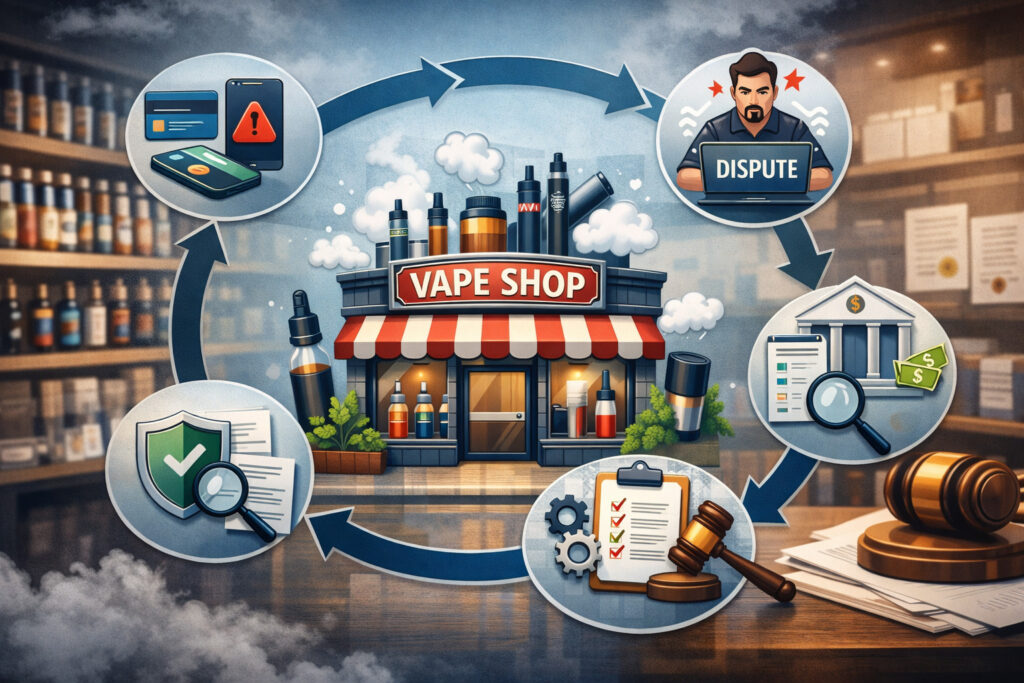
To manage chargebacks in vape retail transactions, you need to understand the flow from purchase to dispute and the decision points where you can intervene.
- Transaction happens (card present or online): Data is created: receipt, authorization response, AVS/CVV results (online), EMV tags (in-store chip), customer info, order confirmation, and policy acceptance.
- Customer complaints or bank disputes are filed: Many customers skip your support channel and go directly to the issuer. This is common with subscription-style purchases, returns that feel slow, or shipments that require adult signature.
- You receive a retrieval request or a chargeback: Some disputes begin as an “information request.” Others go straight to chargeback. Your acquirer/processor will pass along reason codes and deadlines.
- Representment (your response) or acceptance: You either fight the dispute with evidence or accept it. In vape retail transactions, picking the right battles matters: winning rates depend heavily on reason code, proof quality, and whether your policies were properly disclosed.
- Pre-arbitration / arbitration (rare but possible): Networks allow escalation if both sides continue to disagree, but costs can rise quickly, so you should treat arbitration as an exceptional path.
A clean internal process—intake, evidence assembly, response templates, and post-mortem—turns chargebacks in vape retail transactions from chaos into a controllable KPI.
Key Regulations and Governing Bodies That Shape Vape Chargeback Outcomes
Chargebacks in vape retail transactions don’t exist in a vacuum. They are affected by consumer protections, network rules, and category-specific compliance expectations.
From the consumer side, the Fair Credit Billing Act (FCBA) establishes billing-error dispute rights and outlines how creditors must handle consumer complaints, investigations, and acknowledgments. While FCBA doesn’t define every network procedure, it shapes the overall landscape that makes chargebacks a mainstream remedy.
From the tobacco/vape compliance side, federal enforcement and retailer education resources emphasize age restrictions and compliant retail practices. FDA retailer compliance tools highlight the legal age change to 21 and retailer-focused compliance resources.
When a vape retailer is accused of improper sales or unclear practices, it can influence the “fairness” lens an issuer uses while reviewing chargebacks in vape retail transactions.
For shipping and delivery, the PACT Act (enforced by ATF) includes ENDS and is designed to prevent unlawful sales and shipments, including to minors. Postal rules implemented through USPS guidance and a federal rulemaking process treat ENDS as generally nonmailable, subject to narrow exceptions.
These restrictions directly impact “item not received” and “refund not processed” chargebacks in vape retail transactions when customers don’t understand delivery constraints.
Finally, the card networks themselves set dispute frameworks, monitoring programs, and evidence expectations—so compliance is both regulatory and network-based.
Card Network Monitoring Programs: The Metric Pressure Behind Vape Chargebacks

Vape retailers often learn the hard way that disputes aren’t only about losing a transaction—they can threaten the ability to process payments if ratios become unhealthy.
Visa has consolidated monitoring into VAMP and communicated transition details, including advisory and enforcement timelines in 2025.
Industry analysis of Visa’s VAMP changes explains that the program consolidates prior approaches and applies new metrics, which means merchants must manage both fraud and disputes more holistically.
The practical impact is simple: chargebacks in vape retail transactions can become a portfolio risk, not a single-event loss.
Mastercard maintains formal compliance programs and merchant rules resources that cover chargeback-related monitoring, including the Excessive Chargeback Program (ECP) listed within its compliance program framework.
Mastercard also publishes a Chargeback Guide that outlines dispute categories and operational guidance, which you should treat as required reading if you accept Mastercard in a vape retail environment.
What this means operationally:
- Your “chargeback rate” is not just a number—it’s a payment survivability metric.
- Prevention is cheaper than representation.
- One broken process (refund delays, unclear descriptors, weak ID verification, sloppy shipping comms) can cascade into chargebacks in vape retail transactions that push you into monitoring thresholds.
The Most Common Reason Codes Driving Chargebacks in Vape Retail Transactions
Chargebacks in vape retail transactions usually cluster into a few categories. Understanding these categories helps you build targeted defenses.
- Fraud/Unauthorized: Customer claims they didn’t authorize the purchase. For online vape sales, your best tools are strong identity signals (AVS, CVV, device fingerprinting), delivery proof, and customer-account logs. In-store, EMV chip liability rules typically help you—if you used a chip and captured the correct data.
- Item Not Received: Often tied to adult-signature requirements, address issues, carrier delays, or porch theft allegations. Vape merchants must link tracking, carrier scans, and signature/age-verification delivery outcomes to the dispute file.
- Not as Described / Defective: Common when customers misunderstand product compatibility (coil resistance, pod versions), nicotine strength, or device specs. These chargebacks in vape retail transactions are reduced by better product pages, compatibility checkers, and “opened e-liquid” policy clarity.
- Credit Not Processed: Refund policies that are vague—or refunds that take too long—are a major driver. Fast, well-documented refunds reduce disputes dramatically.
- Duplicate/Incorrect Amount: Usually internal POS issues, staff error, or batch settlement problems. Clean POS workflows and receipt discipline matter.
Network reason-code structures and categories are covered in merchant-focused guides and network documentation, and Mastercard provides extensive operational reference material in its chargeback guide.
Prevention Layer 1: Storefront and POS Controls (Card-Present)
If you run a physical vape store, you can reduce chargebacks in vape retail transactions with disciplined in-store controls. Card-present chargebacks often come from confusion, buyer’s remorse, or allegations of incorrect amounts—less often from true fraud when chip is used correctly.
Start with EMV chip acceptance as your default. Train staff to insert chip, not swipe. If a chip fails, follow your terminal prompts. Document exceptions, because “fallback” swipes can create liability exposure.
Next, enforce receipt best practices:
- Print or email receipts that show store name, contact info, return policy reference, and itemization.
- Make sure the descriptor customers see matches your store branding as closely as possible (work with your processor/acquirer on descriptor setup). Confusing descriptors are a top driver of “I don’t recognize this charge” disputes.
Operationally, build a “moment of truth” script:
- Confirm total before tapping/inserting.
- Offer digital receipt by default.
- If a customer is buying a device + consumables, clarify separate items.
Finally, keep the refund discipline. If you issue a refund, ensure it’s properly processed through the terminal as a refund (not a cash adjustment), and give the customer a refund receipt.
Many “credit not processed” chargebacks in vape retail transactions happen because the customer never received clear proof that a refund was initiated.
Prevention Layer 2: Online Checkout Controls (Card-Not-Present)
Online sales are where chargebacks in vape retail transactions can get expensive fast. Your goal is to prevent unauthorized purchases and reduce post-purchase regret triggers.
Use AVS and CVV rules that match your risk tolerance. Decline high-risk mismatches for first-time buyers. Consider step-up verification for risky orders, such as requiring account login, one-time passcode, or manual review.
Add 3-D Secure (3DS) where available and appropriate. When implemented correctly, it can shift liability for certain fraud disputes and reduce unauthorized chargebacks in vape retail transactions. Even when it doesn’t shift liability, it often filters risky buyers and improves issuer confidence.
Deploy velocity controls:
- Limit transactions per card per hour/day.
- Limit failed payment attempts per IP/device.
- Block high-risk BIN ranges if needed (but be careful about false positives).
Add customer identity signals:
- Device fingerprinting
- IP geolocation consistency checks
- Email/phone reputation scoring
- Address validation and apartment/unit normalization
For vape retail, tie fraud controls to age gates (discussed below). In practice, when you combine identity + age verification signals, you reduce both unauthorized disputes and “friendly fraud” chargebacks in vape retail transactions.
Age Verification, Compliance, and Their Hidden Link to Chargebacks
Age-restricted compliance is not only a legal requirement—it’s a chargeback reducer.
If your process is inconsistent, you trigger:
- Customer disputes (“sale shouldn’t have gone through,” “merchant shouldn’t ship here,” “order canceled but charged”)
- Delivery failures (adult signature required, package returned)
- Refund delays after failed delivery
FDA provides retailer-focused compliance resources and emphasizes the legal minimum age at 21, along with retailer compliance materials. Separately, ATF explains the PACT Act’s scope and enforcement collaboration relating to ENDS and prevention of sales/shipments to minors.
From a payments perspective, here’s the best-practice workflow:
- Age gate at site entry (not sufficient alone, but helpful for intent).
- Age verification at checkout using a reputable solution (documented pass/fail outcome).
- Adult signature / age verification at delivery where required or policy-chosen, with clear customer communication.
Chargebacks in vape retail transactions often fall when customers understand why a delivery requires extra steps and what happens if they miss delivery attempts. Your policies must be visible before purchase, and your confirmation emails must restate them.
Shipping and Delivery: PACT Act and Postal Rules as Chargeback Triggers
Shipping is a major driver of chargebacks in vape retail transactions, especially “item not received” and “refund not processed.”
The PACT Act, as described by ATF, was amended to include ENDS and is enforced to prevent unlawful shipments, including to minors. USPS-related rulemaking and guidance also treat ENDS as generally nonmailable, subject to limited exceptions, which can affect how you fulfill orders and what carriers you use.
To reduce disputes, build a shipping system that is “dispute-ready” by default:
- Store tracking numbers and carrier scan history per order.
- Capture adult signature outcomes (delivered, refused, attempted, returned).
- Message customers proactively about delivery windows and signature requirements.
- Provide a self-service portal for address corrections before shipment.
When a package is returned or refused:
- Trigger an automatic support case.
- Communicate refund timing clearly.
- Issue refunds quickly and store proof.
Customers file chargebacks in vape retail transactions when they feel ignored. Transparent timelines and proactive shipping communication often prevent the chargeback before it happens.
Refunds, Returns, and “Credit Not Processed” Disputes
The fastest way to reduce chargebacks in vape retail transactions is to fix refund friction.
Many disputes labeled “credit not processed” are not malicious. They happen because:
- The customer expected an instant refund
- The merchant promised a timeframe but missed it
- The refund was issued incorrectly (void vs refund vs partial)
- The customer used a different card, or the original card was replaced
Your operational controls should include:
- A written refund policy visible at purchase
- A standardized internal refund SLA (example: “refund within 2 business days after inspection”)
- Refund receipts and email confirmations
- A refund status link customers can check
Also, make your policy product-specific. Vape retail has items that cannot be resold once opened (e-liquid) and items that can be tested/defective (devices). Customers accept strict policies when they are clearly presented before purchase—and that clarity reduces chargebacks in vape retail transactions.
Evidence That Wins: What to Submit in a Vape Chargeback Response
Winning chargebacks in vape retail transactions depends on matching evidence to the reason code and showing the issuer a clear story.
Your evidence toolkit should include:
- Order invoice with itemization and SKU-level detail
- Proof of customer identity and purchase flow (account login, IP/device match, AVS/CVV results—when permitted to share)
- Policy acceptance logs (checkbox + timestamp + IP)
- Shipping proof (tracking, delivery scan, signature)
- Customer communication history (emails, chat transcripts)
- Refund documentation (receipt + processing date)
- Photos or QA logs (for defective/not-as-described claims)
For Mastercard, the Mastercard Chargeback Guide provides a structured view of dispute handling and reason-code pathways—use it to align evidence to the dispute type.
Real-World Examples: How Vape Merchants Lose (and Win) Chargebacks
Example 1: “Unrecognized charge” at a storefront
A customer visits twice in one day—once for coils, once for a device. Statement shows a legal entity name they don’t recognize. They dispute one charge.
Fix: descriptor alignment + receipts with contact info + “same-day multi-purchase” cashier script. This reduces chargebacks in vape retail transactions caused by confusion.
Example 2: “Item not received” for an online order
Package required adult signature. The carrier attempted delivery twice; the customer wasn’t home. Package returned. Customer disputes instead of contacting support.
Fix: proactive SMS/email with signature requirement + self-service reschedule + auto-refund workflow upon return. Better comms reduce chargebacks in vape retail transactions dramatically.
Example 3: “Not as described” for device compatibility
Customer bought pods that fit a different version. Product page didn’t clarify compatibility.
Fix: compatibility selector + clearer product photography + “final sale if opened” policy plus a one-time exchange option for unopened items. That mix reduces friendly fraud while improving genuine customer satisfaction.
These examples show a core truth: chargebacks in vape retail transactions are often a symptom of a broken customer journey.
Building a Chargeback Operating System (COS) for Vape Retail
If you want lasting reduction in chargebacks in vape retail transactions, you need a repeatable operating system—not heroics.
A solid COS includes:
1) Ownership and cadence
Assign a chargeback owner. Review disputes weekly. Track root causes monthly.
2) Data discipline
Capture reason codes, dispute amounts, product types, fulfillment method, first-time vs returning customer, and refund timelines. This makes chargebacks in vape retail transactions measurable and fixable.
3) Playbooks
Create standard response templates for:
- Unauthorized/fraud
- Item not received
- Not as described/defective
- Credit not processed
- Duplicate/incorrect amount
4) Prevention backlog
Every chargeback category should feed a “fix list” for product pages, checkout rules, shipping comms, and refunds.
5) Partner alignment
Acquirer/processor alignment matters because monitoring programs exist and enforcement can escalate as ratios rise. Visa’s published VAMP transition details highlight why merchants and acquirers must coordinate controls and compliance expectations.
Future Predictions: Where Chargebacks in Vape Retail Transactions Are Headed
Chargebacks in vape retail transactions are likely to evolve in predictable directions over the next 12–36 months:
- More network pressure on combined fraud + dispute metrics: Industry analysis of Visa’s VAMP changes points to consolidation and expanded measurement approaches that count broader dispute and fraud signals. Expect more merchant attention on “payment integrity” instead of treating fraud and disputes separately.
- More identity and age-verification convergence: Merchants will increasingly combine identity proofing, age verification, and delivery verification into one risk layer. This reduces unauthorized disputes and also reduces “I didn’t get it” disputes.
- More automation in representation: Evidence packaging will become more standardized, with systems that auto-pull tracking, policy acceptance, and customer comms into a dispute file.
- Higher customer expectations for instant refunds: When customers don’t see a refund quickly, they’ll dispute. Vape retailers that build fast refund operations will see fewer chargebacks in vape retail transactions, even if they keep strict product policies.
- Better “pre-dispute” customer experience: Merchants will invest in order lookup, self-service returns, and real-time shipping alerts. That reduces the emotional trigger that causes disputes.
FAQs
Q.1: What is the #1 cause of chargebacks in vape retail transactions?
Answer: For many vape merchants, it’s a tie between unauthorized/fraud (online) and item not received / delivery friction (especially when adult signature is involved). The underlying driver is usually weak identity checks or unclear delivery expectations. Fixing verification and communication reduces chargebacks in vape retail transactions quickly.
Q.2: Are chargebacks the same as refunds?
Answer: No. A refund is initiated by the merchant. A chargeback is initiated by the cardholder through their bank, under dispute rights and network rules. Consumer billing dispute rights are shaped by frameworks like the FCBA, which outlines investigation and handling expectations for billing complaints.
Q.3: How can I reduce “unrecognized charge” disputes?
Answer: Align your descriptor with your store brand, put clear contact info on receipts and confirmation emails, and respond fast to customer inquiries. Many chargebacks in vape retail transactions start because the customer can’t identify the merchant name on their statement.
Q.4: What evidence is most important for “item not received” disputes?
Answer: Carrier tracking, delivery scans, and signature proof are critical. Because ENDS shipping is heavily constrained and often involves special handling, ensure your records are audit-grade.
USPS guidance and rulemaking confirm ENDS are generally nonmailable with limited exceptions, so your shipping method and documentation must be precise.
Q.5: Can I win “unauthorized” chargebacks for online vape orders?
Answer: Sometimes, but it depends on the authentication and evidence. Strong AVS/CVV match results, 3DS authentication (when used), customer account logs, and delivery confirmation improve win rates. Still, prevention is often the better ROI for chargebacks in vape retail transactions.
Q.6: How do monitoring programs affect my business?
Answer: If your dispute metrics get too high, your acquirer may impose fees, require remediation, or restrict processing. Visa’s VAMP program details show the networks’ increasing emphasis on ecosystem-wide monitoring and compliance coordination.
Mastercard also maintains compliance programs and publishes merchant risk resources, including chargeback guidance.
Conclusion
Handling chargebacks in vape retail transactions comes down to building a system that prevents disputes, documents every critical step, and responds with clear, reason-code-matched evidence.
The winning formula is consistent:
- Tighten checkout and POS controls
- Make age verification and delivery expectations explicit
- Treat refunds as a customer experience priority
- Keep dispute-ready documentation from day one
- Run a weekly chargeback review and a monthly root-cause fix cycle
Because vape retail sits at the intersection of restricted-product compliance and high-friction fulfillment, you can’t “hope” your way into lower disputes. You need an operating system.
When you implement one, chargebacks in vape retail transactions stop being a scary surprise and become a manageable metric—one that protects revenue, preserves processing stability, and keeps your business scalable in a stricter payments environment.