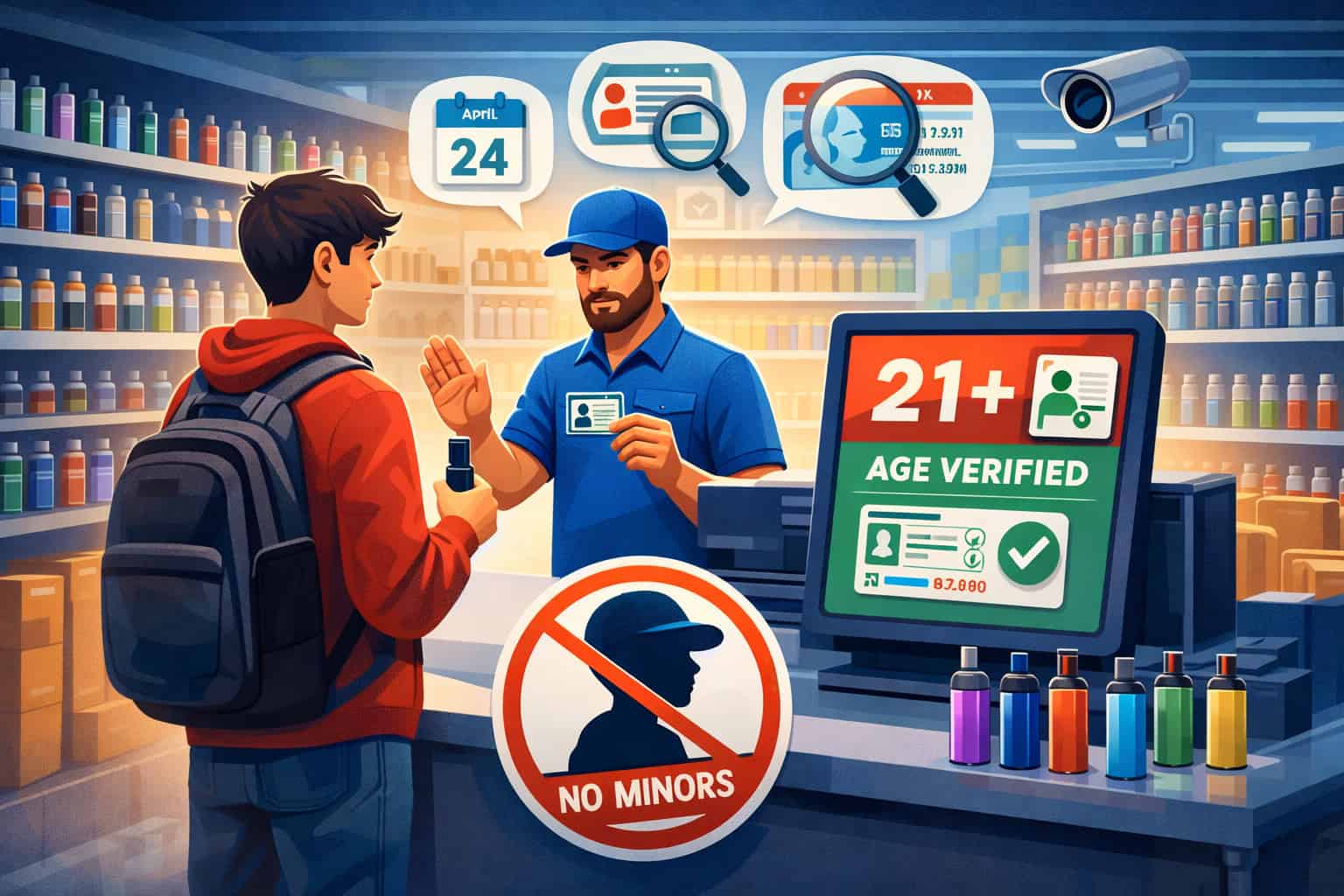
Running a vape shop today is less about “just retail” and more about operating a regulated nicotine business with real legal exposure.
Vape retail compliance is the system you build—policies, training, technology, recordkeeping, store design, and culture—to make sure every sale is lawful and defensible, especially when it comes to preventing underage sales.
Underage prevention isn’t only a moral issue or a community expectation. It’s also a repeatable operational discipline: check ID correctly every time, refuse confidently, document what matters, and remove friction points that cause staff to “wing it” during rushes.
When that discipline is missing, you don’t just risk fines—you risk license impacts, civil money penalties, “no-tobacco-sale” orders, payment interruptions, shipping restrictions for online orders, and reputational damage that is hard to reverse.
This guide is written from an operator’s perspective: the way you’d build vape retail compliance if your goal is to pass inspections, reduce chargebacks and disputes, protect your staff from confrontation, and keep your store profitable.
It also reflects how regulators and governing bodies expect retailers to behave: verifying age for nicotine sales, enforcing minimum legal sales age rules, and following delivery-sale requirements where applicable.
Understanding the Legal Framework That Drives Vape Retail Compliance
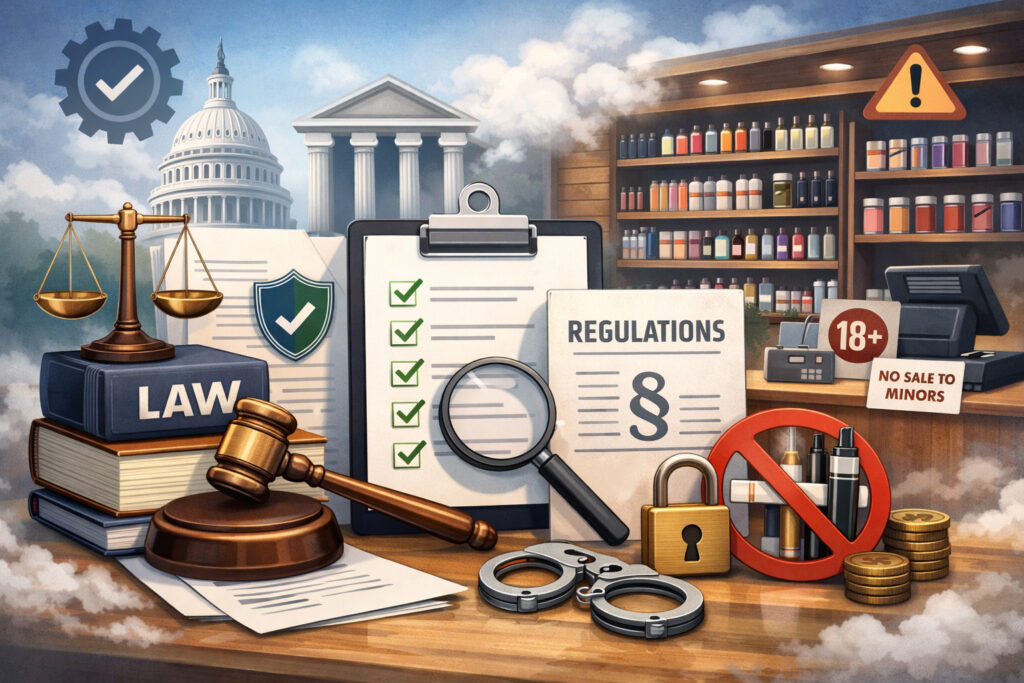
Vape retail compliance starts with knowing which rules apply to you and why enforcement happens the way it does. In most jurisdictions, nicotine products—including ENDS (electronic nicotine delivery systems)—are treated as “tobacco products” for retail-age compliance purposes.
That’s why the same operational expectations used in tobacco retail inspections are applied to vape stores: clear age-gating, consistent ID checks, restricted self-service, and a documented program to prevent youth access.
At the federal level, the minimum legal sales age is 21 for tobacco products, including ENDS, and retailers are expected to comply across all channels—counter sales, curbside, delivery handoff, and online orders. This change took effect December 20, 2019, and there are no “small shop” exceptions.
Another key driver is inspection and compliance monitoring infrastructure. Youth-access prevention has long been tied to state enforcement activity, including compliance checks and retailer violation rate targets under programs influenced by federal funding rules.
Even when the age threshold referenced by certain legacy programs differs, the inspection mindset remains the same: retailers must reliably refuse sales to underage buyers and be able to show they have controls in place.
Minimum Legal Sales Age and “Card Everyone” Policies
A strong vape retail compliance program treats age verification as a process, not a judgment call. Relying on “they look old enough” is exactly what compliance checks are designed to exploit.
That’s why modern best practice is to card every customer (or at least everyone under a set threshold like 30 or 40) and to make the threshold non-negotiable.
Regulators emphasize minimum legal sales age rules and provide tools like an FDA age calculator to support consistent verification decisions at the point of sale.
That matters because “mistakes” usually happen in predictable situations: busy periods, familiar customers, customers accompanied by older friends, or staff who are conflict-avoidant. A hard “card everyone” rule reduces the need for staff to guess and makes refusals feel routine instead of personal.
Operationally, a carding policy must define: acceptable IDs, how to handle expired IDs, what to do with vertical IDs, how to validate date of birth quickly, and when to call a manager. Your vape retail compliance standard should also define “no ID, no sale” and treat it as a safety policy for staff—like refusing alcohol sales—so employees feel protected when a customer argues.
When you build the policy this way, preventing underage sales becomes consistent, auditable, and easier to train—because every sale follows the same steps.
Delivery Sales, Online Orders, and Shipping Compliance
If you sell online or ship products, vape retail compliance becomes more complex because you are managing “delivery sales” obligations, not just counter transactions. Federal law governing certain tobacco product shipments imposes strict requirements designed to prevent online sales to minors, including age verification measures and delivery controls.
In practice, preventing underage sales online typically requires a two-step approach: (1) verify age at the time of purchase using reliable data sources, and (2) ensure the package is delivered with adult signature and proper handoff controls.
This is not the same as a simple checkbox that says “I’m 21.” Your checkout flow should be a real age gate, and your fulfillment process should use carriers and services that support compliant delivery (including adult signature where required).
The business risk here is bigger than many retailers expect. Shipping programs can be terminated, packages can be seized or returned, and merchants can face penalties for systematic noncompliance.
Even if you use a third-party platform, your shop is still responsible for vape retail compliance decisions—especially around age-gating and proof of delivery.
A practical compliance posture is to treat online orders like “high scrutiny” sales: more verification, more documentation, more friction. That friction protects you.
Building a Store-Level Compliance Program That Actually Works

A compliance program is only as good as its worst shift on its busiest day. Vape retail compliance has to survive real-life retail conditions: long lines, new hires, impatient customers, and frequent product changes. The strongest programs are built like a “retail playbook” with simple rules, visible cues, and accountability loops.
Start with written standards that are easy to follow. Then design your store operations so the compliant choice is the easiest choice.
For example: the register prompt forces DOB entry; IDs are checked before product discussion; high-risk items aren’t accessible; and refusals are supported by management. When that’s done well, preventing underage sales becomes routine and measurable.
Your program should also define who owns compliance. In many successful shops, the owner or GM is the compliance officer, and one supervisor per shift is responsible for spot checks and coaching. That role assignment matters because it creates a “chain of responsibility” you can point to during an inspection.
Finally, your program should include continuous improvement: track refusal rates, review incident logs, update training, and correct weak points. Regulators don’t expect perfection—but they do expect that vape retail compliance is intentional and improving.
Written Policies, Signage, and Customer-Facing Messaging
Signage is not a compliance program, but it is part of a defensible system. Your store should have clear age restriction signage at the entrance and at every point of sale, reinforcing that ID is required.
This supports vape retail compliance in two ways: it sets expectations before the customer reaches the counter, and it gives staff an external “policy reference” during refusals.
Written policy matters more. A good policy document includes: minimum sales age, mandatory ID check threshold, acceptable IDs, handling of questionable IDs, refusal scripting, recordkeeping, and escalation procedures. Keep it simple enough that a new hire can internalize it quickly.
Customer-facing messaging should be calm, consistent, and non-accusatory. For example: “We ID all customers—thank you for helping us follow the law.” This reduces confrontation and normalizes the process. When preventing underage sales is framed as a community standard, not a personal judgment, customers argue less.
Also build a clear policy for “third-party purchase” concerns (someone older buying for someone younger). Staff should be trained to pause the transaction and refuse when circumstances indicate a proxy purchase attempt.
That’s a common underage access pathway, and shops that ignore it often fail compliance checks even when they technically carded the buyer.
This combination—policy + signage + scripting—is core to vape retail compliance because it turns a legal requirement into a repeatable customer experience.
Staff Training, Roleplay, and Refusal Skills That Reduce Risk
Most compliance failures are human failures: a rushed cashier, a new employee, a confusing ID, or fear of conflict. That’s why vape retail compliance training should be practical and scenario-based, not just a slideshow.
Training must include hands-on ID practice: reading DOB quickly, checking expiration, looking for tampering, verifying photo matches, and recognizing common red flags (blurry print, uneven fonts, mismatched height/eye color, odd hologram behavior).
Then add roleplay—because refusing a sale is a skill. Staff should practice short scripts like: “I can’t complete this sale without a valid ID. I can help you once you have it.” The goal is calm repetition, not debate.
You also need “manager support rules.” Employees should know they will never be punished for refusing a questionable sale. If staff believe management will override refusals to “save the sale,” your vape retail compliance program will collapse. Consistency matters more than revenue from a single transaction.
A strong training cadence includes: onboarding certification, 30-day refresher, quarterly micro-trainings (10–15 minutes), and shift-lead coaching during busy periods. Document attendance and keep signed acknowledgements.
This is one of the most powerful ways to prevent underage sales: you make the compliant behavior feel normal, expected, and protected.
Point-of-Sale Controls and Technology for Age Verification
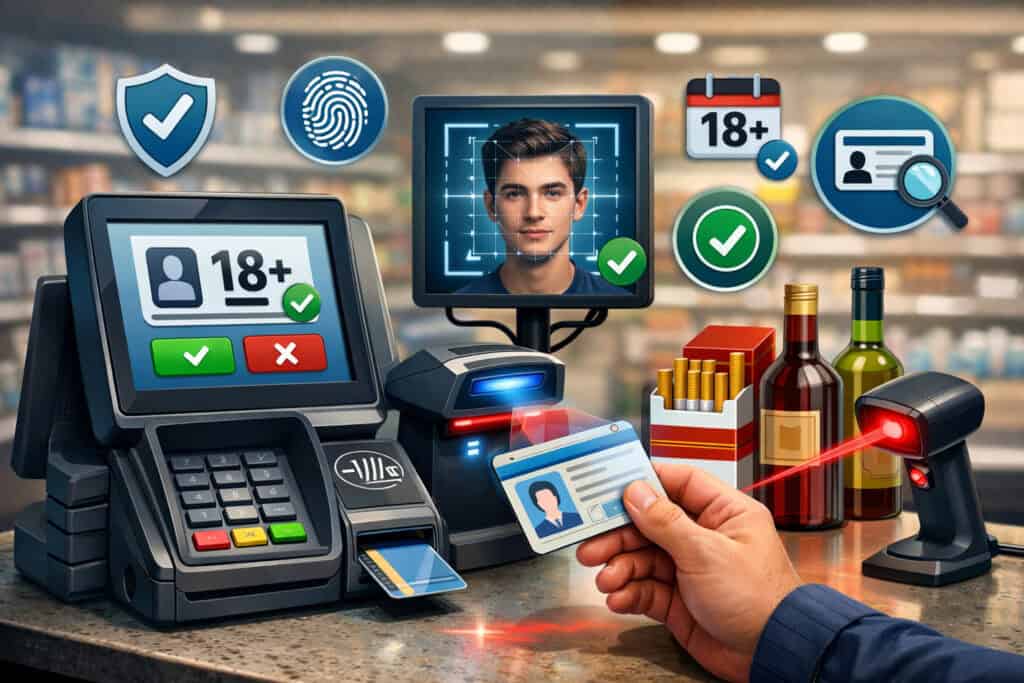
Technology is not a substitute for good judgment, but it can make vape retail compliance more consistent and defensible. The best POS controls reduce the chance of “skipping steps” when the line is long. They also create a record that you can use to show your program is systematic.
At minimum, your POS flow should require DOB entry for age-restricted items and should block the sale when DOB indicates the customer is underage. Ideally, it also prompts staff to scan an ID or confirm the ID type.
Some systems integrate ID scanners that parse the barcode on government IDs to reduce manual errors. Those tools can speed up transactions while improving consistency—if staff are trained to still visually check the ID photo and signs of tampering.
The FDA also offers a voluntary age calculator app designed to help retailers comply with age restrictions. Tools like that are useful because they reduce math errors—especially for employees who struggle calculating age from DOB under pressure.
For online sales, age verification tech becomes even more important. Your checkout should use reputable age verification methods that rely on data sources, not self-attestation, and your fulfillment should enforce adult signature requirements when applicable.
ID Scanning, Age Calculators, and “Friction by Design”
“Friction by design” means you intentionally add small steps that prevent big mistakes. In vape retail compliance, the right friction is asking for ID early and verifying it the same way every time.
An ID scanner can help, but it isn’t magic. Barcodes can be spoofed, and some fake IDs scan successfully. That’s why the right workflow is: scan ID to capture DOB, then visually confirm photo match and ID integrity. Train staff to treat scanning as “step one,” not “proof.”
Age calculators are another simple win. Retailers can use calculator tools so staff don’t miscalculate age near birthdays. The FDA’s age calculator app exists specifically to support consistent decisions at retail.
Friction also includes store layout and checkout design. If staff must leave the register to grab products, they may forget to check ID before completing the transaction.
A better approach is to check ID before product retrieval or before any price discussion for age-restricted items. That makes preventing underage sales the first step, not the last-minute hurdle.
You can also use on-screen prompts: “ID checked? Yes/No.” Even if it’s simple, it creates a habit loop. Over time, your vape retail compliance becomes muscle memory, not a special event.
This is how you build a system that protects your store even when the perfect employee isn’t on shift.
Audit Trails, Logs, and Evidence That Protect Your Business
When a compliance problem happens, the question quickly becomes: “Can you show you had a system?” Vape retail compliance isn’t only about what you do—it’s also about what you can prove.
Your recordkeeping should include: training logs, signed policy acknowledgements, incident/refusal logs, POS age-verification settings, and any internal audit notes. If you use ID scanning, understand what data you store and whether privacy rules or company policy require minimizing retention. Store only what you need, and protect it.
Refusal logs are especially useful. A simple log entry—date/time, reason for refusal, staff initials, and any escalation—shows your shop actively prevents underage sales. It also helps you identify trends: certain shifts, certain products, certain times of day.
Internal audits matter too. Many strong operators run “mystery shopper” style checks with a manager posing as a customer (of-age) to confirm the ID process is followed. The point is not to punish—it’s to catch drift.
When regulators see documentation and continuous improvement, they are more likely to view your business as a serious retailer rather than a repeat risk. Your vape retail compliance posture becomes a shield.
Preventing Underage Sales in High-Risk Scenarios

Underage attempts are not random. They cluster around predictable situations: weekends, evenings, busy periods, new product releases, and stores near schools or youth hangouts. Vape retail compliance should explicitly address these high-risk patterns.
One major scenario is the “group dynamic.” A younger customer may come in with an older friend, hover near the counter, and direct the purchase. Staff sometimes card only the buyer and complete the sale. A stronger approach is to watch for “selection by proxy” and refuse if it appears to be a third-party purchase for someone underage.
Another scenario is “confidence tactics.” Some underage buyers act overly confident, present an ID quickly, pressure the cashier, or become indignant to force a rushed approval. Your staff training should teach the opposite response: slow down, verify carefully, and repeat the policy calmly.
Also watch for product-specific risk. Certain categories (like disposable flavored products in some markets) may attract youth interest. Your staff should be trained to treat certain requests as a prompt to verify ID earlier and more carefully.
Preventing underage sales is about identifying these patterns and building counter-moves into your daily operations. That’s what mature vape retail compliance looks like.
Handling Fake IDs, Proxy Purchases, and Social Engineering
Fake IDs are often “good enough” to fool an untrained cashier. Vape retail compliance needs a clear counterfeit-ID playbook that staff can follow without escalating conflict.
Teach staff to look for consistency: photo match (face shape, ears, chin, hairline), DOB format, expiration, hologram behavior, lamination edges, and unusual thickness.
If your state issues vertical IDs for younger drivers, train staff on what that means and what it doesn’t mean (vertical format doesn’t automatically mean underage, but it requires careful DOB reading).
Proxy purchases are trickier. Signs include: a younger person selecting the product while the older person pays, “text me which flavor,” or a group waiting outside. Your policy should empower refusal when staff reasonably suspect a third-party purchase. Make sure managers back these calls.
Social engineering includes emotional manipulation: “I’m in a hurry,” “I forgot my ID but I come here all the time,” “My kid is in the car,” or “Other stores let me.” Train staff to use one script and one outcome: no valid ID, no sale.
From an expert retail lens, your goal is to remove decision fatigue. Vape retail compliance works when staff don’t have to invent responses—they execute a routine.
Store Layout, Product Access Controls, and Visual Deterrence
Physical design plays a bigger role in preventing underage sales than many retailers realize. Vape retail compliance improves when your store layout supports controlled sales rather than self-service behavior.
Avoid letting customers handle nicotine products before ID verification. Even if they can’t steal them, handling encourages “shopping behavior” that can turn into pressure at checkout. Keep age-restricted inventory behind the counter or in controlled displays.
Use clear age-gate signage at the door and at the register so the message lands early. If your store has a waiting area, place the sign where people naturally look while waiting. Visual deterrence reduces arguments because customers can’t claim surprise.
Design your register area so staff can see the entrance and the line. Underage attempts often depend on timing—catching a distracted cashier. Better sightlines mean better control.
Finally, implement an “ID first” flow: train staff to ask for ID before discussing products in detail. That prevents your employees from investing time, building rapport, and then feeling awkward refusing at the end. It’s a small change with a big impact on vape retail compliance consistency.
Over time, these design choices create a store environment where preventing underage sales is the default expectation, not a dramatic confrontation.
Regulatory Enforcement, Inspections, and What Inspectors Look For
To build effective vape retail compliance, you need to think like an inspector. Inspections and compliance checks are designed to answer one question: “Does this retailer reliably prevent youth access?” That’s why enforcement focuses on observable behaviors—ID checks, signage, self-service controls, and repeatable procedures.
Retail compliance efforts are connected with broader youth-access programs and inspection activities. Federal agencies have partnerships and program structures that support retailer compliance checks and monitoring across jurisdictions.
At the same time, the regulatory environment around vaping products continues evolving. For example, federal regulators maintain authority over which products can be marketed and sold, and product authorization decisions can affect what retailers should stock.
In recent years, courts have also weighed in on the regulator’s authority around flavored vape products—reinforcing that the regulatory landscape can shift and retailers should be careful about sourcing and product legitimacy.
From a retailer standpoint, the smartest approach is to run your store as if a compliance check could happen today: because it can.
Preparing for Compliance Checks and Reducing Violation Risk
The stores that pass checks consistently do a few things differently. First, they treat vape retail compliance as daily operations, not “inspection mode.” That means the ID process is identical whether the customer is a regular, a friend, or a new face.
Second, they train for pressure. Rush periods are where mistakes happen. A best practice is to assign a “line manager” during peak times—someone who helps keep the counter orderly so the cashier can verify ID without distraction.
Third, they keep compliance visible. Managers do quick shift huddles: “Remember, ID everyone.” They also spot-check by asking cashiers, “What’s our ID policy?” This keeps preventing underage sales at the top of mind.
Fourth, they review failures like an incident response. If someone almost sells without checking ID, you treat it like a near-miss, not a shrug. You debrief, retrain, and adjust the process so it doesn’t happen again.
Finally, they document. If you can show training records, refusal logs, and a consistent policy, your vape retail compliance posture is stronger even when a mistake occurs.
This preparation mindset reduces violations and builds a culture where compliance is part of professionalism.
Penalties, Business Impact, and Why “One Mistake” Can Snowball
Retailers sometimes underestimate how expensive a single underage sale can become—because the cost isn’t only the penalty. The real cost is operational disruption: staff stress, reputational damage, increased scrutiny, and in some cases restrictions that affect your ability to sell.
Penalties can escalate with repeat issues. Even without listing every possible enforcement action, the pattern is consistent: repeat failures lead to stronger consequences. That’s why vape retail compliance is designed to prevent “the first failure” and to prove that your shop is not a habitual risk.
There’s also indirect impact: your processors, insurers, landlords, and suppliers can become nervous if your business is associated with underage sales. For shops that sell online, failing age verification expectations can jeopardize shipping relationships and increase disputes.
A real-world example: a shop near a college area cards inconsistently because many customers “look old.” After one failure, the shop increases carding temporarily.
Over time, old habits return—then a second failure happens. At that point, the business is labeled “high risk,” staff turnover increases, and the owner spends time reacting instead of growing the store.
Future Trends in Vape Retail Compliance and Underage Prevention
Vape retail compliance is moving toward higher accountability, better data, and more technology-enabled enforcement. Even if specific rule changes vary by jurisdiction, the direction is clear: regulators and communities expect stronger youth-access controls, especially in online channels and in high-risk retail environments.
One trend is the increasing expectation of robust age verification for delivery sales and shipping. As enforcement tightens around online access, “checkbox age gates” will continue to be viewed as insufficient, and retailers will be pushed toward database-backed verification and verified delivery handoffs.
Another trend is product legitimacy scrutiny. Retailers will need to pay closer attention to authorized vs. unauthorized products and supply chain documentation, because product enforcement and authorization decisions influence what can be legally marketed.
There’s also a policy trend around flavors and youth appeal. Court decisions and regulatory actions indicate continuing focus on whether products attract youth, which can translate into stricter retail expectations and more targeted inspections.
For operators, the future-proof strategy is to build a compliance system that is adaptable: easy to update, easy to retrain, and easy to audit.
Digital ID, Biometric Verification, and Privacy-Safe Implementation
Over the next few years, more retailers will adopt digital tools to reduce human error. Digital ID verification—where permitted—can make vape retail compliance faster and more consistent, especially when paired with policies that still require a visual check.
Biometric verification (like face matching) may appear in some online contexts, but retailers should be cautious. Biometrics raise privacy and data-security concerns, and the compliance benefit must be weighed against customer trust and legal obligations. A safer direction for many businesses is privacy-minimizing verification: confirm age eligibility without storing unnecessary personal data.
A practical “future-ready” approach is to implement:
- POS age prompts + optional ID scan
- Verified online age checks through reputable providers
- Delivery controls with adult signature where required
- Short retention windows for verification logs
- Clear privacy notices at checkout
This approach supports preventing underage sales while reducing the risk of becoming a “data warehouse” of sensitive customer information.
The key idea is that modern vape retail compliance will increasingly be judged by whether your systems are resilient and defensible—not whether your cashier “usually remembers.”
Evolving Product Rules, Enforcement Priorities, and Retailer Adaptation
Retailers should expect continuing change in product oversight and enforcement priorities. Regulatory bodies retain authority over which nicotine products can be legally marketed, and court decisions have reinforced that authority in key cases involving flavored products.
For stores, this means compliance is not only about age checks. It’s also about inventory discipline: sourcing from legitimate distributors, keeping invoices, avoiding questionable gray-market items, and being prepared to respond if certain categories become enforcement targets.
Enforcement capacity can also fluctuate over time due to organizational changes. That uncertainty doesn’t reduce your responsibility—it increases the importance of self-enforcement. Your vape retail compliance program should be strong enough that it doesn’t depend on “how often inspections happen.”
From a business standpoint, adaptability wins:
- Review product categories quarterly
- Update staff scripts when rules change
- Maintain supplier documentation
- Run internal audits
- Keep training fresh
This is how you stay compliant—and stay open—while the market evolves.
FAQs
Q.1: What is the single most effective step to prevent underage sales?
Answer: The most effective step is a strict, consistent ID policy that is followed 100% of the time. In practice, that means “card everyone” or “card anyone who appears under 30/40,” with no exceptions for regulars or “they look old.”
Consistency is what prevents mistakes during busy shifts. Using an age calculator tool also reduces DOB math errors and makes your vape retail compliance decisions more defensible.
Q.2: Are vape products covered by the same minimum age rules as other tobacco products?
Answer: Yes. Federal minimum age rules apply to tobacco products, and regulators treat ENDS products within that framework for retail sales compliance. Retailers are expected to prevent sales to anyone under 21, and the rule applies broadly across retail settings.
Q.3: If a customer refuses to show ID, can we complete the sale if they look over 21?
Answer: No. A “no ID, no sale” rule should be non-negotiable in your vape retail compliance program. Visual age estimation is unreliable and is exactly where compliance failures happen. A calm refusal script and manager support protect staff and reduce confrontation.
Q.4: What should we do if we suspect a proxy purchase?
Answer: Train staff to pause and refuse when there’s reasonable suspicion that an of-age buyer is purchasing for someone underage. Your policy should explicitly empower refusals in these situations. Preventing underage sales includes preventing third-party purchases, not just checking the buyer’s ID.
Q.5: Do online orders require more than a checkbox age gate?
Answer: In most compliant models, yes. Delivery sales and shipments can trigger stricter expectations, including age verification processes and delivery controls designed to prevent youth access. Build your online flow to verify age with reliable methods and to control delivery handoff appropriately.
Conclusion
Vape retail compliance is the discipline of making underage sales structurally difficult—no matter who is working, how busy the store is, or how persuasive the customer sounds.
The strongest programs combine clear policies, relentless consistency, staff training that includes refusal skills, POS controls that reduce skipped steps, and documentation that proves your system is real.
If you want preventing underage sales to be reliable, build a routine: ID first, verify the same way every time, refuse without debate, log incidents, and coach continuously.
Align your online and shipping operations with age verification expectations and delivery controls. Use tools like age calculators to reduce errors.
Finally, think ahead. Enforcement priorities and product rules will continue to evolve, and retailers who treat vape retail compliance as a living system—not a one-time checklist—will be the ones who stay resilient, protect their teams, and maintain long-term profitability.