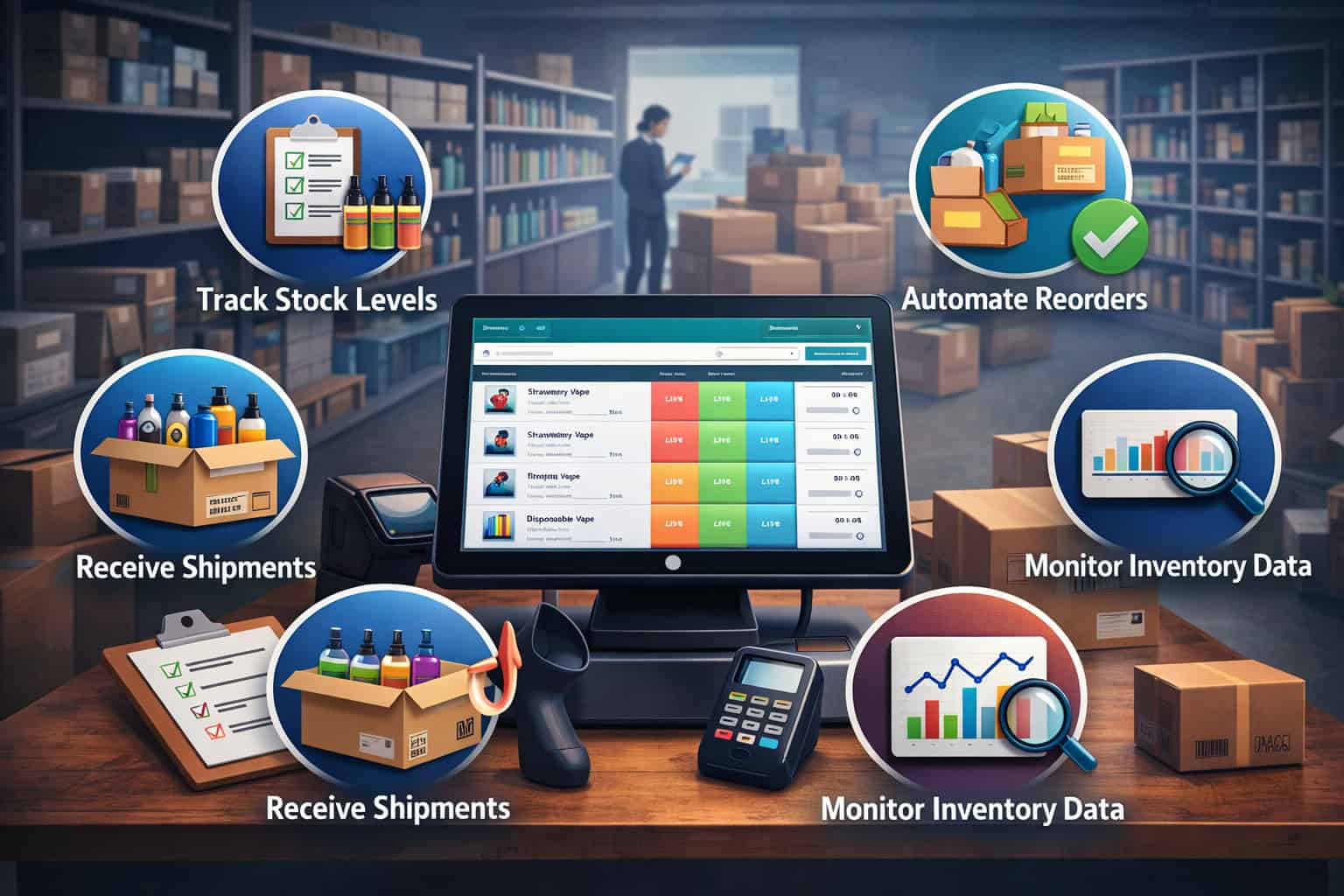
Vape distribution is a high-velocity, high-compliance business where inventory accuracy is profit. A single mismatch—wrong nicotine strength shipped, discontinued flavor still showing “available,” a case pack miscount, or a backorder that wasn’t communicated—can ripple into chargebacks, returns, damaged retailer relationships, and regulatory exposure.
That’s why more wholesalers rely on a modern POS not just for “checkout,” but as the operational hub that connects purchasing, receiving, warehouse movement, allocation, compliance, invoicing, and analytics.
In distribution, the POS functions like a hybrid: part inventory management, part order management, and part warehouse control.
When configured correctly, a distributor POS becomes the system of record for every unit that enters and exits the business—across multiple locations, sales channels, and customer types.
In this guide, you’ll see how distributors use a POS to build clean product data, automate receiving, control stock across warehouses and routes, reduce shrink, improve fill rates, and meet documentation expectations tied to federal and state oversight.
You’ll also get real-world examples and practical workflows you can apply whether you run a regional warehouse, a multi-location distribution network, or a cash-and-carry operation with wholesale accounts.
Why Inventory Is Harder in Vape Distribution Than in Most Wholesale Verticals

Vape inventory looks simple until you manage it at scale. You don’t just stock “devices” and “e-liquid.” You stock device generations, coil resistances, pod compatibility, battery formats, colorways, and bundle kits.
For consumables, you track brand, flavor, nicotine strength, bottle size, ratio, and frequently changing packaging. The product catalog grows fast, and the lifecycle is short. Items rotate, regulations shift, and consumer trends can change in weeks.
From an operations standpoint, distributors also carry inventory risk that typical wholesalers avoid. Many retailers expect broad availability, fast replenishment, and flexible terms.
That means you may hold deeper stock on best sellers while also carrying niche SKUs to protect share-of-wallet. Without a disciplined POS inventory approach, you get the two most expensive problems at once: dead stock and stockouts.
Compliance pressure also shapes inventory management. Vape and related nicotine products sit in a regulated environment where age restrictions, product authorization status, shipping limitations, and reporting obligations can materially affect distribution.
Agencies like the FDA’s Center for Tobacco Products regulate aspects of tobacco products and ENDS distribution and marketing, while the ATF enforces key parts of the PACT Act framework that can impact interstate delivery sales and record access.
That combination—fast-moving SKUs, short lifecycles, and documentation risk—is exactly where a distributor-grade POS becomes valuable. It forces structure: standardized SKUs, controlled pricing, traceable transactions, and measurable warehouse processes.
What a “Distributor POS” Really Means (And How It Differs From Retail POS)

A retail POS is designed for scanning items at a counter, collecting payment, and printing a receipt. A distributor POS can do that too, but the real value is behind the scenes.
In distribution, the POS must support “B2B reality”: case packs, pallet quantities, customer-specific price levels, credit terms, partial shipments, backorders, allocations, and route delivery.
A capable vape distributor POS usually includes:
- A product information master (attributes, variants, UoM, barcodes, tax flags)
- Purchase order workflows (vendor cost tiers, lead times, reorder points)
- Receiving tools (blind receiving, discrepancy handling, put-away rules)
- Warehouse controls (bins, zones, pick paths, cycle counting)
- Sales order management (quotes, approvals, credit checks, split shipments)
- Customer pricing engines (price levels, contract pricing, promotions)
- Compliance logic (age-gate requirements where applicable, customer eligibility, restricted item controls)
- Audit-grade reporting (transaction history, user logs, inventory adjustments)
Think of the POS as the conductor. Your warehouse team, sales reps, buyers, and accounting are all playing different instruments. Without a single system of record, you get noise: duplicate SKUs, mismatched costs, and “inventory by spreadsheet.” With a distributor POS, inventory becomes a controlled process rather than a guessing game.
A practical way to evaluate your current setup: if you can’t answer “Where did this case go?” or “Why did our on-hand change?” within two minutes, your POS and inventory workflows are not doing the job.
Building a Clean Product Catalog in POS: SKUs, Variants, and Barcode Standards
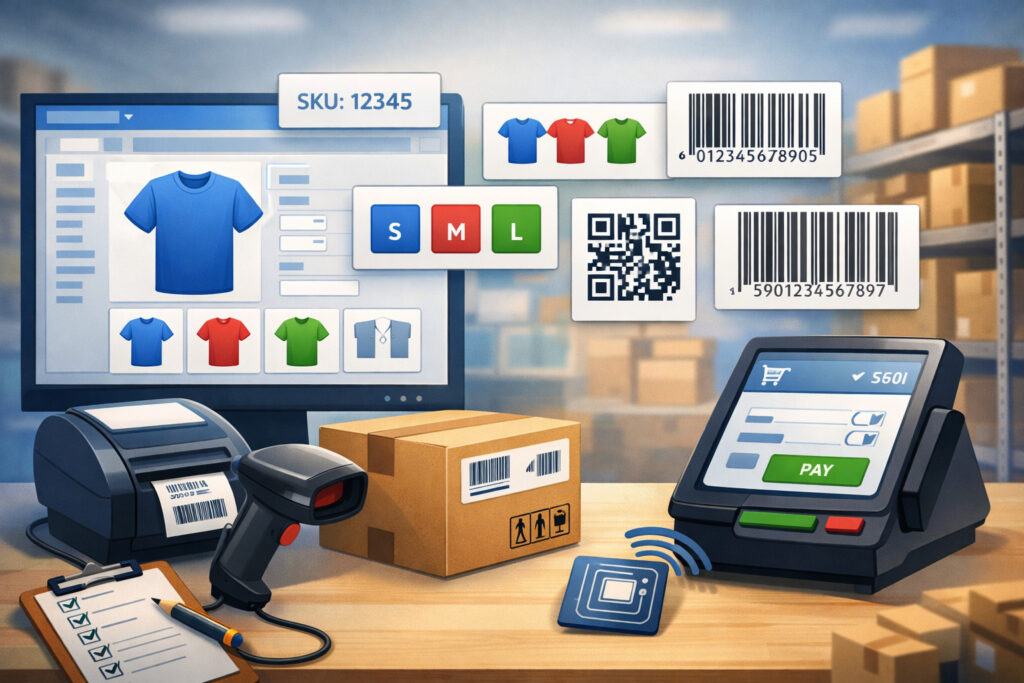
Inventory accuracy starts before the first shipment arrives. If your product catalog is messy, the warehouse will be messy. Distributors that win long-term treat product setup as a discipline: consistent SKU structure, standardized naming, and required attributes.
SKU architecture that scales
A distributor-friendly SKU format encodes what matters operationally. For example:
- Brand + Line + Flavor + Strength + Size (for liquids)
- Brand + Device + Generation + Color (for disposables/devices)
- Coil family + Resistance + Pack size (for coils)
This matters because your sales team searches the catalog all day, and your warehouse picks against it all night. A consistent SKU design reduces mis-picks and speeds training.
Barcode discipline: UPC/GTIN, internal barcodes, and scan reliability
Many vape products already carry UPCs. Your POS should store each scannable barcode per unit of sale and map it to the correct UoM (single unit, pack, case). When barcode data is inconsistent, distributors often create internal labels to guarantee scan accuracy for picking and receiving.
Industry barcode standards governed by organizations like GS1 support consistent identification across supply chains and are widely used for retail and wholesale scanning. Building your POS around these standards reduces friction with retailers and makes EDI and catalog sharing easier.
Mandatory attributes for vape distributor POS catalogs
To protect margins and reduce returns, advanced distributors store key attributes as structured fields (not just in item descriptions):
- Nicotine strength and formulation flags
- Bottle/pod count per pack
- Coil resistance
- Device compatibility
- “Discontinued / Do not reorder” lifecycle status
- Hazard/handling flags where applicable (battery shipping constraints, etc.)
- Supplier authorization documentation references (where you track it)
When your POS catalog is structured, you can run powerful controls: block sale of discontinued items, prevent substitution errors, and build pick lists that minimize confusion.
Receiving in POS: Turning Vendor Shipments Into Accurate On-Hand Inventory

Receiving is the moment your business either gains control—or loses it. Distributors that struggle with shrink often discover the root cause is poor receiving discipline: rushed counts, no discrepancy workflow, and no accountability.
A vape distributor POS typically supports receiving in a few common modes:
Purchase order receiving with tolerance rules
Your buyer creates a PO with expected quantities and cost. When the shipment arrives, the receiver confirms:
- Quantity received
- Barcode match to SKU
- Cost/landed cost variance
- Damaged or shorted items
Tolerance rules are important. For example, you might allow a small overage on promotional bundles, but require manager approval for any cost variance above a threshold. That keeps vendor errors from silently becoming margin losses.
Blind receiving to reduce bias
In blind receiving, the receiver does not see the expected quantities on the screen. They count what’s actually there. This prevents “rubber-stamping” the PO and dramatically reduces the chance of accepting a short shipment as correct.
Put-away workflows: bins, zones, and directed stocking
After receiving, the POS should produce put-away tasks: where to store it, what bin, what zone. Directed put-away matters in vape distribution because SKU density is high and packaging often looks similar. If two flavors look alike, bin discipline is the difference between 99.5% pick accuracy and expensive mis-shipments.
Real-world example: A mid-size distributor receiving 200+ lines a week used to “stage everything on pallets” until someone had time to stock it. They constantly showed inventory available in POS but couldn’t find it physically.
After implementing POS-driven receiving + bin put-away, their average order processing time dropped and customer backorders fell because “available” finally meant “pickable.”
Warehouse Control With POS: Bins, Pick Paths, Cycle Counts, and Shrink Reduction
Inventory isn’t just “how many.” It’s where and why. Vape distributors that rely on a POS for warehouse control use four practices to keep inventory trustworthy.
Bin-level inventory and directed picking
A distributor POS with bin tracking assigns each SKU to one or more bin locations. Pick tickets tell the picker exactly where to go and how many to pick from each bin. This reduces walking time and prevents “I grabbed the wrong flavor” errors.
If your POS doesn’t support bins, you’ll eventually end up with informal systems—markers on shelves, sticky notes, tribal knowledge. Those systems fail when your best warehouse employee takes a vacation.
Pick paths and wave picking
High-volume distributors create pick paths (a logical walking route). Some POS systems support wave picking: group many orders into one pick run, then sort at a packing station. This is huge for vape because many orders are small but frequent.
Cycle counting, ABC analysis, and root-cause adjustments
Instead of shutting down for a full physical count, top distributors do daily or weekly cycle counts:
- A items (top sellers) counted more often
- B items counted on a regular cadence
- C items counted less frequently
The POS should log every adjustment with reason codes (damage, vendor short, theft, mis-pick correction, recount). That audit trail helps you fix process issues instead of repeatedly “writing off” losses.
Shrink controls that actually work
Shrink in vape distribution often comes from:
- Receiving errors
- Mis-picks and mis-shipments
- Untracked samples
- Uncontrolled returns processing
- Unauthorized discounts or giveaways
A distributor POS reduces shrink by forcing every movement to be recorded: receiving, transfers, returns, write-offs, and samples. When your POS records who did what and when, teams become more careful, and managers can pinpoint where controls are failing.
Managing Variants, Lots, and Shelf Life in Vape Distributor POS Workflows
Not every distributor needs pharmaceutical-grade traceability, but vape distribution still benefits from structured tracking—especially with fast product turnover and frequent packaging updates.
Variant control: the most common expensive mistake
Variants are where most returns are born. A customer ordered 5% nicotine, you shipped 2%. Or they ordered a specific pod version, you shipped the previous generation. In a strong POS setup, variants are not “notes.” They are separate SKUs with forced scanning and pick validation.
FIFO vs FEFO: protecting freshness and reducing write-offs
Some vape consumables are sensitive to shelf life or have “best by” considerations even if not strictly regulated as food or medicine. Distributors often use FIFO (first in, first out) or FEFO (first expired, first out) logic. A POS that supports received-date tracking (and, if needed, lot codes) helps reduce stale inventory and supports cleaner rotations.
Lot/batch capture when you need it
If you work with manufacturers who provide lot codes, capturing them at receiving can protect you during supplier quality issues. It allows targeted recalls or holds without freezing your entire catalog.
Practical approach: even if you don’t run strict lot tracking for everything, many distributors at least track lots for high-risk categories (select liquids, new launches, or products with frequent changes). Your POS should allow “track by lot” on an item-by-item basis so you don’t overcomplicate the entire warehouse.
Multi-Location Inventory: Transfers, Cash-and-Carry, and Route Truck Stock
Many vape distributors operate more than one facility: a primary warehouse plus a counter-sales location, or multiple regional hubs. The moment you add a second site, inventory accuracy becomes harder—unless the POS is built for multi-location controls.
Inter-warehouse transfers with accountability
Transfers should be formal documents in your POS, not “we loaded a van.” A proper transfer workflow includes:
- Transfer order creation (what should move)
- Pick confirmation (what actually moved)
- Shipment confirmation (left the origin)
- Receiving confirmation (arrived at destination)
This prevents phantom inventory where both locations think they own the same cases.
Cash-and-carry operations without chaos
Many distributors sell wholesale at a counter. The risk is that counter staff “just ring it up” while warehouse inventory is managed separately. A unified POS avoids that split-brain problem. Every counter sale reduces the same on-hand that your warehouse pickers rely on.
Route truck inventory and mobile selling
If you run routes, truck stock becomes a moving warehouse. The POS should support:
- Loading trucks as transfers
- Sales off the truck (invoice generation)
- Returns and unsold goods reconciliation at end of route
Real-world example: A distributor with two delivery trucks reduced end-of-week discrepancies by turning each load-out into a POS transfer document and requiring scan-in/scan-out. Their “mystery losses” became measurable events: damage on route, customer returns, or loading mistakes.
Demand Forecasting and Purchasing: Using POS Data to Prevent Stockouts and Dead Stock
Buying decisions are where profit is made or lost. In vape distribution, forecasting is tricky because trends move fast and product life cycles are short. A distributor POS helps by converting sales history into reorder signals.
Reorder points, safety stock, and lead times
At minimum, your POS should support:
- Average weekly sales per SKU
- Vendor lead time (days)
- Safety stock targets (buffer inventory)
- Reorder points and reorder quantities
This lets buyers avoid emotional purchasing (“we should buy more of everything”) and instead buy based on velocity and risk.
Seasonality and promotion effects
Demand can spike around holiday periods, local events, or retailer promotions. Strong distributors tag promotions in the POS so they can separate “true baseline demand” from “promo-driven spikes.” Otherwise, you overbuy after a promo ends and sit on inventory.
Vendor performance tracking
Distributors also use POS analytics to grade suppliers:
- Fill rate and backorder frequency
- Lead time reliability
- Cost variance trends
- Return rates by vendor
That data supports better negotiations. If a vendor repeatedly shorts shipments, you can tighten receiving tolerances or adjust reorder points. If a vendor’s costs creep up, you can reprice faster.
The key is discipline: your POS must be the source of truth. If sales reps take orders outside the system or warehouse staff ships outside the pick workflow, your forecasting will be wrong.
Pricing, Promotions, and Margin Control in Vape Distributor POS
In distribution, pricing is a system—not a number. Vape distributor POS setups usually need to handle multiple customer segments:
- High-volume retailers
- Smaller smoke shops
- Chain accounts
- Online wholesale accounts
- Cash-and-carry walk-ins
Tiered pricing and customer-specific price books
Instead of editing prices manually, distributors set price levels (Tier A, Tier B, Tier C) tied to customer groups. Some also create contract pricing for specific accounts. That prevents pricing chaos and protects margins when staff changes happen.
Promo engines that don’t destroy margin
Promotions are common in vape distribution: bundle pricing, buy-more-save-more, vendor-funded discounts. A POS should let you:
- Set promo start/end dates
- Limit by SKU/category/vendor
- Apply quantity thresholds
- Track promo performance (did it lift volume or just cut price?)
Costing method matters
Your POS costing method—average cost, FIFO cost, or landed cost—affects margin visibility. Distributors often add landed cost components like freight, pallet fees, or vendor surcharges. If those costs sit outside the POS, your “margin report” becomes fiction.
A strong vape distributor POS setup shows margin by SKU and by customer, so you can spot problems early—like a rep discounting too aggressively, or a vendor cost increase that hasn’t been reflected in your sell price.
Compliance and Documentation: How POS Helps You Stay Audit-Ready
Compliance is not just a legal topic—it’s an operations topic. If your POS can’t produce documentation quickly, your team ends up scrambling, and operational risk increases.
Age restriction frameworks and controlled selling
Retailers are subject to minimum-age sales requirements, and federal rules raised the minimum age to 21 for tobacco products, including e-cigarettes. FDA provides retailer guidance and enforcement information around these requirements.
Distributors support compliance by controlling who they sell to and by documenting customer eligibility. A good POS can:
- Require customer accounts to be approved before purchasing restricted items
- Flag restricted categories
- Record tax/license IDs and expiration dates where relevant
- Lock account access if documents expire
PACT Act operational impact: registration, reporting, record access
The PACT Act framework, enforced by the ATF, includes requirements tied to delivery sales and expects sellers to comply with state and local licensing and tax rules. The ATF provides guidance on registration and compliance expectations.
Many distributors use their POS to centralize:
- Customer records by jurisdiction
- Delivery sales documentation
- Invoice history and shipment records
- Monthly reporting exports (where applicable)
You’re not “doing compliance” just by having a policy. You’re doing it by having retrievable records. The POS is where those records live.
Product authorization awareness (PMTA context)
FDA’s PMTA framework and related regulations affect which products are legally marketed and emphasize recordkeeping expectations for manufacturers and related parties.
Distributors often respond operationally by tracking product documentation status at the catalog level—such as linking vendor-provided attestations or internal compliance notes—so sales teams don’t accidentally push problematic SKUs.
Shipping, Delivery, and Returns: POS Controls That Prevent Costly Mistakes
Distribution profits can disappear in shipping errors. Vape and ENDS shipping is especially sensitive because mailing restrictions and carrier policies can constrain fulfillment options.
For example, USPS updated mailing requirements to treat many ENDS items as generally nonmailable as of October 21, 2021, tied to federal law changes.
A distributor POS helps manage shipping reality by:
Enforcing correct fulfillment methods
You can configure shipping rules in POS so certain product categories cannot be assigned to prohibited shipping methods. That prevents a staff member from selecting the wrong service under pressure.
Packing validation and scan-to-ship
Scan-to-ship confirms that what was picked is what was packed. This is a major win in vape distribution because packaging can be visually similar. When your POS requires scanning at pack-out, mis-ships drop sharply.
Returns and RMA workflows
Returns can destroy inventory integrity if handled casually. Strong distributors use POS-based RMA workflows:
- Record why it came back (damage, wrong item, unsold, defect)
- Decide disposition (restock, quarantine, write-off)
- Tie return to original invoice
- Track vendor credits where applicable
Real-world example: A distributor allowed returns into “a box” until someone processed them. They constantly saw on-hand inflated items that were actually unsellable. After implementing POS RMA controls, they separated restockable inventory from quarantine inventory and stopped overselling.
Reporting and Analytics: Turning POS Inventory Data Into Better Decisions
Once your POS inventory is trustworthy, analytics become a competitive advantage. Vape distributors commonly track:
Fill rate and stockout cost
- Fill rate by customer and by SKU
- Backorder frequency
- Lost sales estimates (demand when out of stock)
High fill rates protect relationships. Retailers reorder from the distributor that has the product available, not the one that “might get it next week.”
Inventory health metrics
- Days of inventory on hand
- Dead stock aging (30/60/90/180+ days)
- Sell-through by vendor and category
Shrink and adjustment analysis
Because every adjustment in a good POS has a reason code and user log, you can isolate patterns:
- Receiving discrepancies by receiver
- Pick errors by shift
- Damage rates by carrier or route
- Theft risk areas (high-value SKUs, unsecured zones)
Analytics are where E-E-A-T shows up operationally. Expert distributors don’t “feel” what’s happening—they measure it, then change the process.
Integrations That Make POS Inventory Stronger: EDI, Accounting, eCommerce, and 3PL
Your POS doesn’t live alone. The more your POS inventory connects to other systems, the less manual work you do and the fewer errors you create.
EDI for wholesale accounts
Larger retailers often want EDI documents like:
- 850 (purchase order)
- 856 (advance ship notice)
- 810 (invoice)
When your POS drives EDI, you reduce rekeying, speed up order processing, and reduce chargebacks from documentation mismatches.
Accounting sync for clean books
A distributor POS typically syncs invoices, payments, credits, and cost-of-goods into accounting software. The key is mapping items and taxes correctly so your inventory valuation isn’t distorted.
eCommerce wholesale portals
Many distributors run a wholesale ordering site. If it isn’t synced tightly to the POS, you oversell. The best setups show real-time availability (or conservative “available to promise”) and push web orders directly into the POS pick workflow.
3PL and multiple warehouses
If you outsource fulfillment, the POS must exchange inventory and shipment confirmations with the 3PL. Otherwise, you’ll be stuck reconciling “their inventory” versus “your inventory.”
Implementation Blueprint: Setting Up a Vape Distributor POS for Inventory Success
A POS implementation fails when it’s treated like software installation instead of operations redesign. The fastest way to win is to build a staged rollout.
Step 1: Normalize your catalog before go-live
- Eliminate duplicate SKUs
- Standardize naming conventions
- Define required attributes
- Clean barcode mappings and UoM definitions
If you don’t do this first, you will import chaos into a new system and blame the POS for it.
Step 2: Define warehouse rules (bins, zones, and receiving discipline)
- Create a location map
- Define bin labels and put-away logic
- Train receivers on discrepancy handling
- Require scan-based receiving where possible
Step 3: Lock down inventory movements
A core rule: if it moves, it’s recorded in the POS. That includes:
- Samples
- Damages
- Returns
- Inter-warehouse transfers
- Route truck loads
Step 4: Build your pricing engine and approvals
- Customer tiers and price books
- Discount limits per role
- Manager approvals for exceptions
Step 5: Measure and improve
After go-live, track:
- Pick accuracy
- Receiving discrepancy rate
- Fill rate
- Inventory adjustment trends
- Order cycle time
Then refine. The POS gives you visibility, but your team’s discipline converts that visibility into profit.
Future Predictions: Where Vape Distributor POS Inventory Is Headed Next
Over the next few years, vape distribution inventory management is likely to become more automated, more data-driven, and more compliance-aware—especially as enforcement priorities and shipping constraints continue to evolve.
Predictive replenishment and AI-assisted purchasing
Expect more POS platforms to offer predictive reorder suggestions that consider:
- Sales velocity
- сезонality patterns
- vendor lead times
- promo calendars
- stockout penalties
This won’t replace buyers. It will reduce guesswork and highlight anomalies faster.
More scanning, less typing: mobile-first warehouse execution
Warehouses are moving toward mobile scanners and app-based workflows: receiving on a tablet, pick confirmation on a handheld, cycle counts via mobile tasks. The end state is near real-time inventory accuracy, not “updated at end of day.”
Stronger product identity and barcode evolution
GS1 continues to advance barcode standards, including expanded data carriers that can hold more information than traditional UPCs. As these evolve, distributors will increasingly use richer product identity to reduce counterfeit risk and improve traceability.
Compliance-linked inventory controls
As rules and enforcement pressures change, distributors will lean on POS controls that can quickly:
- quarantine products
- block sales by jurisdiction
- produce audit-ready reports
The distributors who treat POS inventory as a compliance asset—not just an operations tool—will be positioned to adapt faster.
FAQs
Q.1: What is the best POS inventory setup for a vape distributor with both wholesale and counter sales?
Answer: The best setup is a single POS inventory database that supports both B2B wholesale workflows and counter (cash-and-carry) transactions without splitting inventory into separate systems.
The reason is simple: split systems create “double truth,” and double truth causes overselling, miscounts, and arguments about what inventory is real.
In practice, you want one item master, one on-hand number per location, and one receiving workflow. Counter sales should reduce the same inventory your wholesale team sells from.
Wholesale orders should reserve inventory so counter staff can’t accidentally sell it out from under a large order. The POS should support customer-level pricing tiers, credit terms, and invoice workflows for wholesale, while also supporting quick scan-and-sell at the counter.
Operationally, the biggest win is controlling inventory movements. Returns, damages, samples, and transfers must be processed through the POS, not “handled later.” That discipline keeps the on-hand accurate and prevents the warehouse from becoming a detective agency.
If you’re building this from scratch, prioritize bin tracking, scan-based receiving, and customer pricing levels. Those three features typically deliver the fastest ROI in a vape distributor POS environment.
Q.2: How does a POS help with PACT Act-related recordkeeping and reporting workflows?
Answer: A POS helps because it centralizes the data you need for documentation: customer accounts, invoices, shipment records, and product history. The ATF’s PACT Act guidance emphasizes registration and compliance with state and local licensing and tax rules, and it describes expectations around record access for enforcement and administrators.
From an operations viewpoint, the POS becomes your “single source of truth” for delivery sale transactions. Instead of hunting through email threads, carrier portals, and spreadsheets, you can pull the relevant invoice, customer details, ship-to address, and transaction timestamps from one place.
Many distributors also configure customer profiles to store licensing or tax IDs and expiration dates, so they can control who is eligible to buy restricted categories.
A mature workflow includes standardized exports or reports, role-based access controls, and an audit trail for edits. That matters because the risk isn’t only “did we do it?”—it’s also “can we prove it quickly and consistently?” A POS can’t guarantee compliance by itself, but it can make compliance operationally realistic.
Q.3: Can a POS prevent shipping mistakes when mailing restrictions apply to vaping products?
Answer: Yes—if it’s configured with rule-based fulfillment controls. Mailing restrictions and carrier limitations can change what “normal shipping” looks like. USPS, for example, updated its policies so many ENDS items are generally nonmailable, effective October 21, 2021.
A distributor POS can reduce errors by enforcing shipping method rules at the order level. For instance, if an order contains restricted categories, the POS can block certain fulfillment methods or require manager approval. It can also prevent staff from finalizing a shipment until the correct carrier/service is selected.
Beyond policy controls, the most effective feature is scan-to-ship. If your POS requires scanning each item at pack-out, it dramatically reduces wrong-item shipments—one of the most common profit killers in vape distribution.
When you combine shipping rules with scan validation, you don’t rely on memory or training alone. You rely on a system that won’t let the team make the easy mistake.
Q.4: What inventory counting method works best for vape distributors: full physical counts or cycle counting?
Answer: For most distributors, cycle counting is the best day-to-day method because vape catalogs are large and fast-moving. Full physical counts can still be useful periodically, but they’re disruptive and often become “annual pain” rather than continuous control.
Cycle counting works because it turns inventory accuracy into a routine. You count top-selling SKUs (A items) frequently, medium sellers (B items) on a schedule, and slow movers (C items) less often. The POS should assign count tasks, record variances, and require reason codes for adjustments.
That creates visibility into why inventory goes wrong—receiving errors, mis-picks, damage, theft, or vendor issues.
The biggest advantage is speed of correction. If a best seller is off by 20 units, you want to know this week, not at the end of the quarter. Accurate on-hand improves fill rate, reduces emergency purchasing, and protects customer trust.
In vape distribution, those effects are compounding: better accuracy leads to fewer stockouts, fewer returns, and fewer customer complaints.
Q.5: How do distributors use POS to reduce dead stock when vape trends change quickly?
Answer: Distributors reduce dead stock by using POS analytics to see early warning signals and by enforcing lifecycle controls on SKUs. First, the POS should show inventory aging, days-on-hand, and sell-through trends. If a product’s weekly velocity drops for several weeks, the system should make that visible before you reorder again.
Second, distributors use SKU lifecycle flags in the POS: “active,” “phase-out,” “discontinued,” “do not reorder.” That prevents buyers from accidentally replenishing a product that is fading. It also allows sales teams to move inventory intentionally—through controlled promotions, bundles, or targeted offers to accounts that still sell that category.
Third, distributors tighten purchasing rules with reorder points and safety stock that reflect reality, not optimism. If a SKU is trend-driven, you don’t treat it like a stable commodity. You buy shallower, watch velocity closely, and replenish only when sell-through proves demand.
The best operators also track vendor return/credit terms inside their POS notes and purchasing workflows, because flexible vendor programs can reduce dead-stock risk. Over time, disciplined POS-driven purchasing becomes a core advantage in a trend-heavy market.
Conclusion
For vape distributors, inventory management is not a back-office task—it’s the center of profitability, service quality, and operational control.
A distributor-grade POS turns inventory from a “best guess” into a governed process by enforcing clean product data, disciplined receiving, bin-level warehouse execution, and traceable movements across locations, routes, and returns.
It also supports the documentation reality of regulated categories by centralizing invoices, shipment records, customer profiles, and audit trails—so you can respond quickly when partners, carriers, or regulators require clarity.
Agencies like the FDA and ATF publish guidance that highlights how tobacco/ENDS distribution intersects with retail rules, delivery sales frameworks, and record access expectations, and a strong POS inventory system makes those expectations operationally manageable.
The distributors who win long-term treat the POS as the operating system for the business. They standardize SKUs, require scan-based workflows, measure fill rate and shrink, and continuously refine purchasing with real sales data.
As technology evolves, POS platforms will increasingly add predictive purchasing, mobile-first warehouse execution, and richer product identity standards—making accurate inventory not just possible, but a competitive advantage.