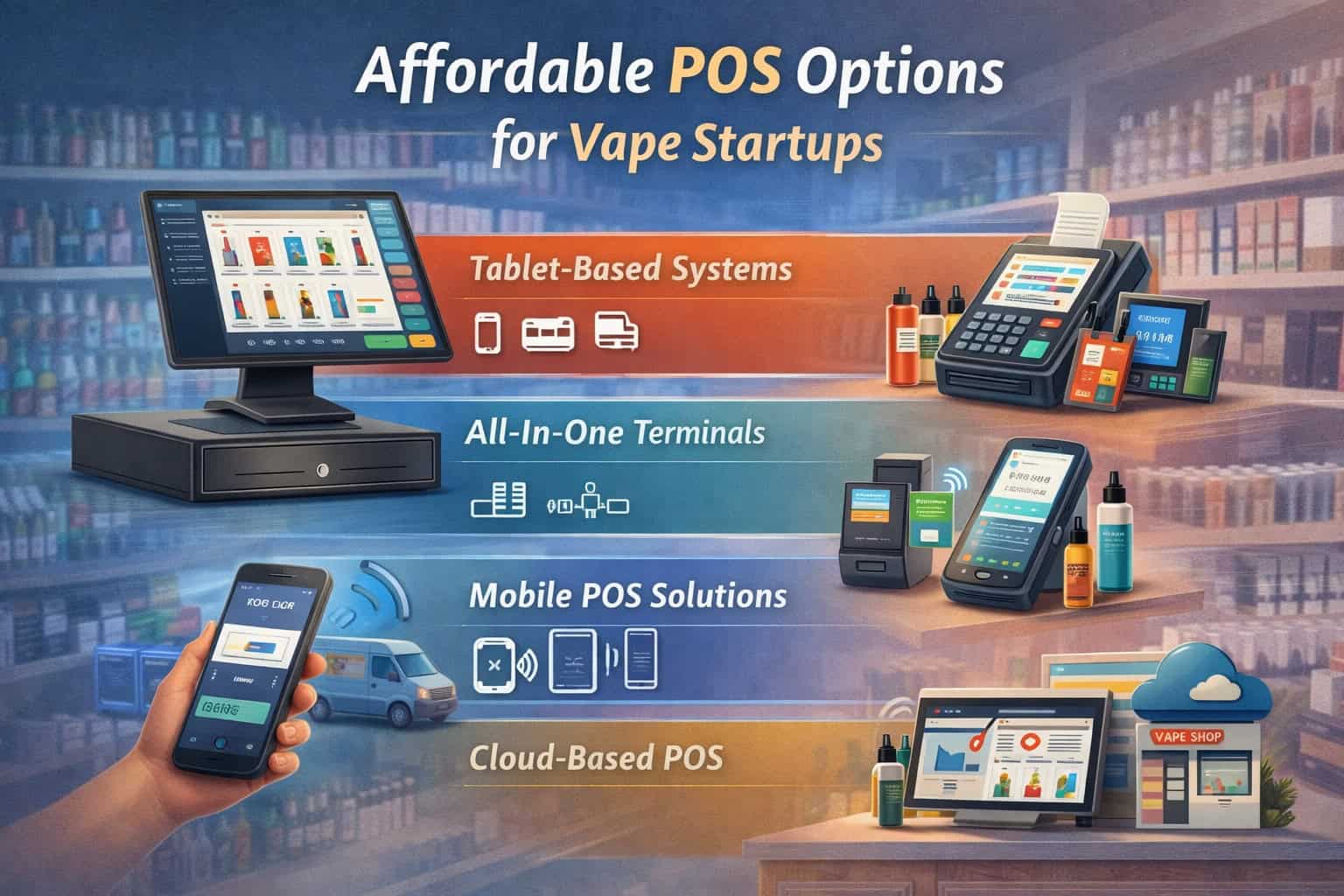
Launching a vape retail business is different from opening a typical convenience store. You’re selling age-restricted products, operating under strict federal and state oversight, and dealing with payments, inventory, and compliance risks that many general retail POS platforms weren’t built to handle.
That’s why choosing an affordable vape Point of Sale isn’t just a “software decision”—it’s a survival decision that can protect your margins, reduce chargebacks, and keep you inspection-ready.
The good news: you do not need an enterprise system to run a professional, compliant operation. The best affordable vape POS setups today are modular—meaning you can start lean and add advanced capabilities like multi-store reporting, eCommerce sync, delivery workflows, and loyalty once revenue is stable.
This guide breaks down affordable vape Point of Sale selection from a real operator’s perspective: what you must have on day one, what you can delay, how to budget accurately, and how to avoid the biggest mistakes that cause payment shutdowns and compliance headaches.
It’s written for startup owners, store managers, and founders who need an affordable vape POS that works in the real world—not a generic “best POS” list.
Why an Affordable Vape POS Is a Startup’s Most Important Tool
A vape startup typically has two constraints at the same time: tight cash flow and high operational risk. That’s exactly where an affordable vape POS earns its value.
Done right, it protects revenue in three ways: it speeds checkout, it reduces losses (theft, shrink, pricing errors), and it minimizes compliance exposure. Done wrong, it becomes a monthly expense that still leaves you vulnerable to penalties, processor holds, and inventory chaos.
First, vape retail has unique inventory complexity. You’ll manage flavors, nicotine strengths, device types, coils, pods, disposable units, batteries, chargers, and accessories—often with dozens of near-identical SKUs.
Without solid barcode workflows and variant management, your “best sellers” become mystery items and your reorder decisions turn into guesswork. A strong affordable vape POS tracks SKU-level sales, margins, and supplier performance so you can build a predictable replenishment cycle.
Second, vape stores win or lose on compliance consistency. Age checks must be routine. Policies must be repeatable. Audit trails matter. A vape-focused affordable vape Point of Sale supports ID prompts, cashier accountability, and exception reporting—so compliance isn’t dependent on memory during a busy rush.
Third, payments and chargebacks can sink early-stage stores. A compliant, stable checkout process—combined with secure device configuration—reduces disputes and “friendly fraud.” The right affordable vape POS doesn’t just ring sales; it supports a low-drama payment environment that processors trust, which helps you avoid sudden account reviews.
Compliance Reality: What Your Vape POS Must Support
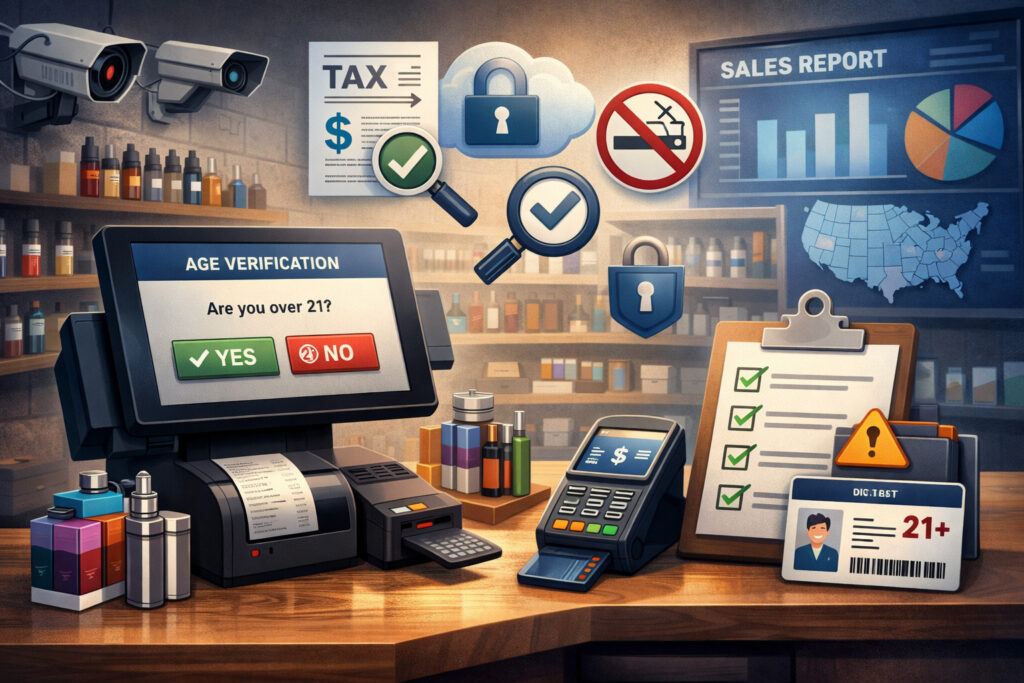
Before you compare features, you need to understand why vape retail is treated differently. Any affordable vape Point of Sale you choose must help you enforce age restrictions, document compliance, and maintain clean transaction records.
At the federal level, the minimum age to sell tobacco products—including many nicotine products—was raised to 21 (“Tobacco 21”). The FDA summarizes this change and its enforcement focus for retailers.
If you operate a vape shop, you should assume you’ll be expected to follow strict age verification processes, train staff, and maintain consistent point-of-sale controls that prevent accidental sales to underage buyers.
If you sell online or ship products, the compliance bar gets even higher. The ATF explains that the PACT Act was amended to cover ENDS (e-cigarettes/vapes) and focuses on preventing sales and shipments to minors.
This affects how you handle delivery verification, adult-signature workflows, shipping carrier rules, and reporting obligations that vary by jurisdiction.
On top of federal rules, state and local regulations can add licensing, flavor restrictions, product definitions, packaging limits, and inspection practices. That’s why your affordable vape POS should not be “just a register.” It should help you standardize age checks, lock down discounts and overrides, and produce clean reporting.
A practical way to think about it: compliance is not a binder on a shelf; it’s daily behavior. A well-configured affordable vape Point of Sale turns that daily behavior into prompts, controls, and logs. That’s what helps startups stay consistent even when staffing changes, lines get long, or new products roll in weekly.
What “Affordable Vape POS” Really Means: Total Cost, Not Just Monthly Price
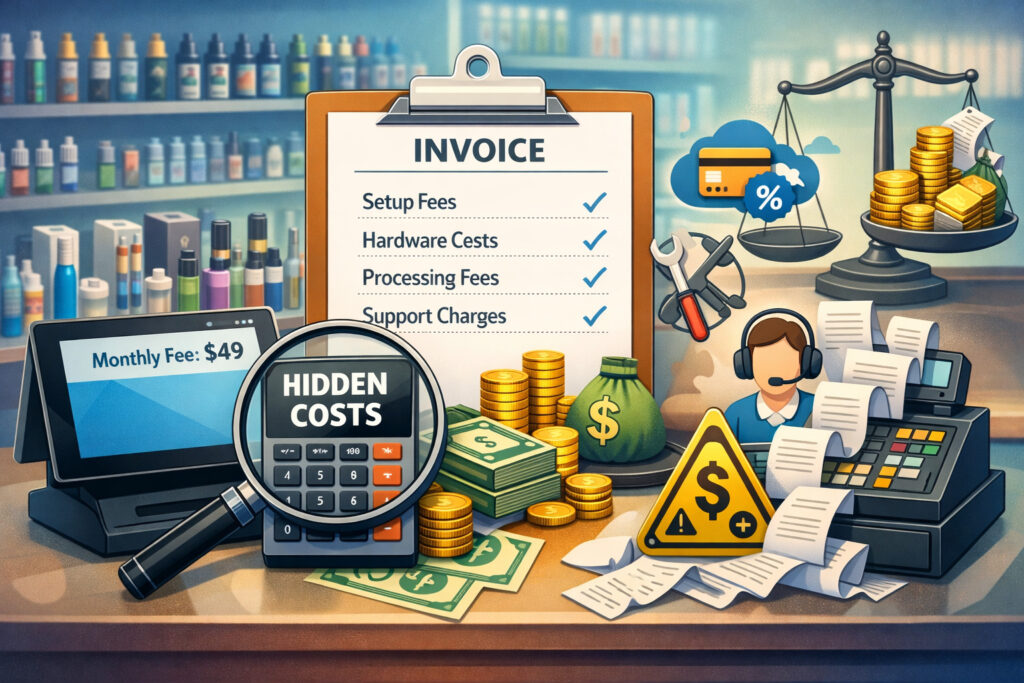
Many founders shop for an affordable vape POS by looking only at the monthly software fee. That’s how you end up overpaying. Real affordability is “total cost of ownership” (TCO): software + hardware + payments + support + downtime risk.
Start with the basics: most Point of Sale vendors charge per register, per location, or per feature tier. The cheapest tier may not include inventory variants, purchase orders, multi-user roles, advanced reporting, or integrations. If you plan to expand, a slightly higher plan now can cost less than migrating later.
Then consider hardware. Tablets are cheap—but retail durability matters. A consumer tablet that fails every 10 months is not “affordable.” The same goes for barcode scanners, receipt printers, cash drawers, and label printers. A smart affordable vape POS plan balances initial spend with reliability.
Payments are a hidden cost category. Some Point of Sale systems bundle payment processing, while others integrate with multiple processors. For vape retail, stability and underwriting fit matter as much as rates. A low advertised rate is meaningless if your account gets frozen during a busy weekend.
Finally, add support and downtime. If your POS goes down, you lose sales, and your staff improvises—often breaking compliance routines. A truly affordable vape POS includes dependable support channels, clear documentation, and offline/backup workflows so you can keep selling while staying compliant.
Non-Negotiable Features in an Affordable Vape POS System
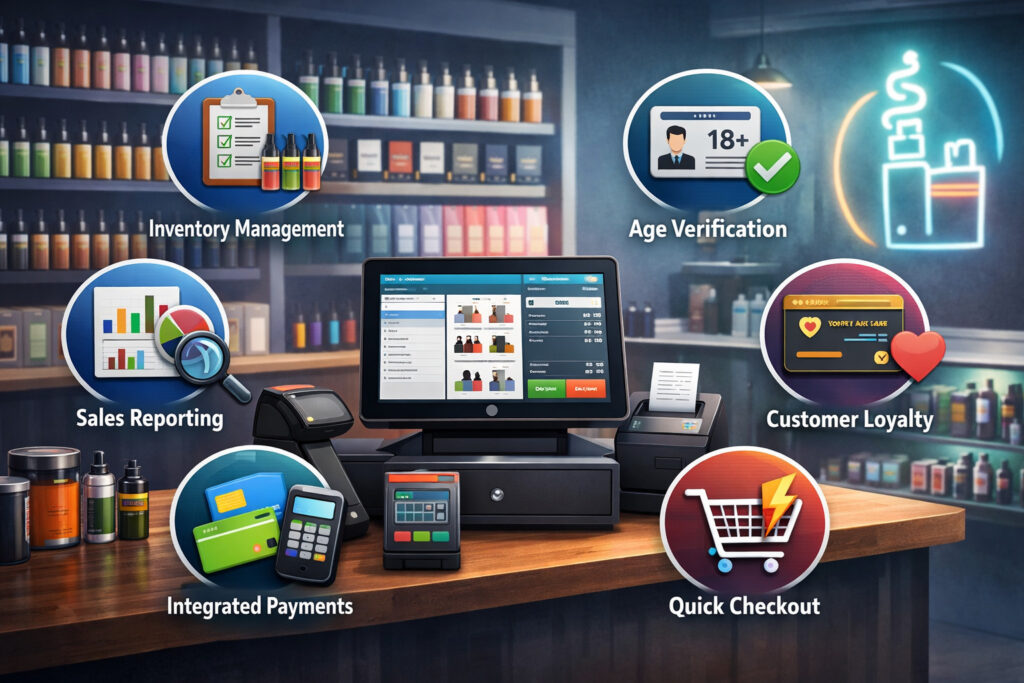
Not every startup needs every feature immediately. But every vape startup needs a baseline set of controls to operate smoothly and safely. A capable affordable vape POS should include the following essentials—because these are the functions that prevent revenue leaks and compliance mistakes.
Age Verification Prompts and ID Workflows
Age gating must be part of the checkout flow, not a poster on the wall. The best affordable vape POS systems can prompt cashiers to confirm ID checks, require a birthdate entry, or support ID-scanning integrations where permitted. The key is consistency: the POS should make it harder to “skip” the verification step during busy hours.
This matters because FDA enforcement and retailer education emphasize preventing youth access and maintaining compliance behaviors at the point of sale. Your system should also log who completed the sale, which register was used, and what overrides occurred.
SKU-Level Inventory With Variants and Barcodes
Vape inventory is variant-heavy. Your affordable vape POS must handle product variants (nicotine strength, size, color, device generation), track quantities by SKU, and support barcode scanning for both receiving and selling. Manual typing is slow and error-prone.
Look for features like low-stock alerts, vendor catalogs, and cost tracking. When you know the landed cost and selling price per SKU, you can protect margin—especially on disposables where price competition can be aggressive.
Role-Based Access and Override Controls
Startups often rely on a small team. That makes access control even more important. Your affordable vape POS should support user roles (cashier, supervisor, manager, owner), PIN logins, and permission settings for discounts, refunds, and voids. This reduces shrink and prevents “helpful” discounts that destroy margin.
Override reporting is equally important. A POS that shows override frequency by an employee helps you spot training gaps and potential internal theft early—before it becomes a serious loss.
Returns, Exchanges, and Warranty-Like Handling
Vape retail has unique return patterns: defective devices, leaking pods, DOA batteries, and customer dissatisfaction. A practical affordable vape POS should handle exchanges without messy accounting. You want clean records that show whether you refunded cash, issued store credit, or swapped for a replacement.
This protects you in disputes and chargebacks because you can document the resolution process clearly. It also protects inventory accuracy so your shrink reporting stays meaningful.
Affordable Vape POS Hardware: What to Buy First and What to Delay
Hardware decisions can make an affordable vape POS either truly affordable or secretly expensive. The goal is to buy the minimum reliable setup that supports compliant, fast checkout—then expand.
Start with one reliable checkout station: a tablet or terminal, a quality barcode scanner, a receipt printer, and a cash drawer (if you accept cash). If your product mix includes many small items, barcode scanning is not optional. It is the speed multiplier that prevents pricing errors.
Next, plan for labeling. Vape stores often repackage bundles, create starter kits, or manage house-branded accessories. A label printer is a major upgrade because it makes inventory management real. If you delay labeling, you’ll spend hours doing “inventory cleanup” later—which is expensive labor.
Consider a customer-facing display if your store is busy. Transparency reduces disputes (“that’s not the price”) and improves perceived professionalism. It also supports better tip prompts if you sell non-age-restricted accessories or services (where tips are appropriate and permitted by your policies).
Finally, plan for resilience. Power outages and internet failures happen. A strong affordable vape POS strategy includes a battery backup for networking gear, and an offline mode or backup checkout method so sales don’t stop.
Payments for Vape Retail: How POS Choice Impacts Account Stability
Vape businesses often fall into “high-risk” categories for payments due to regulatory scrutiny, age restrictions, and dispute patterns. This is not a reason to panic—it’s a reason to plan. The POS you pick can either help or hurt your payment stability.
First, your affordable vape POS should support clean descriptors, consistent receipts, and accurate tax calculation. Many disputes happen because a customer doesn’t recognize the charge or believes they were mischarged. A professional receipt and a consistent merchant descriptor reduce that risk.
Second, your POS should support EMV chip and contactless payments. Chip acceptance reduces counterfeit fraud exposure, especially since the card networks implemented liability shifts for merchants who don’t adopt chip-capable acceptance. Even if you’re a startup, modern acceptance signals legitimacy and reduces fraud-driven chargebacks.
Third, watch for “forced” bundled processing that may not fit vape retail. Some POS companies are optimized for low-risk categories and can shut down accounts quickly when a prohibited product category is detected.
A vape-friendly affordable vape POS approach is one where payments and POS are configured with category alignment, transparent underwriting, and clear product descriptors.
Finally, dispute readiness matters. Your POS should store itemized receipts, refund records, and employee logs. When a chargeback arrives, documentation is your defense. The more structured your POS data is, the easier it is to respond quickly.
Data Security and Trust: PCI DSS and Customer Information Basics
Security isn’t just “IT stuff.” It’s part of protecting your revenue, your reputation, and your ability to keep processing payments. Any store that accepts card payments must take PCI DSS seriously. The PCI Security Standards Council describes PCI DSS as a baseline set of requirements designed to protect payment account data.
A truly affordable vape POS strategy is to minimize what you store. Use EMV and tokenization. Avoid writing card numbers down. Avoid storing sensitive data locally. If your POS vendor offers end-to-end encryption and tokenized receipts, that’s a strong signal.
Also consider customer data beyond payments—like loyalty profiles, phone numbers, and email addresses. If you collect personal information, you should follow reasonable security practices: strong passwords, unique logins per employee, two-factor authentication where available, and vendor access control.
Depending on your business model, you may also encounter security expectations influenced by FTC guidance around safeguarding customer information for covered entities.
Even if you’re not certain whether a specific rule applies to your store, the operational takeaway is still valuable: keep customer information secure, limit access, monitor vendors, and document your controls.
In practice, your affordable vape POS should support: automatic software updates, encrypted connections, audit logs, and role-based permissions. Security becomes “affordable” when it prevents one incident that would otherwise cost you months of profit.
Store Operations That Make an Affordable Vape POS Pay for Itself
The best affordable vape POS isn’t the cheapest subscription—it’s the one that eliminates waste and turns data into better decisions. Here are the operational workflows that create the highest ROI for vape startups.
Smart Reordering and Vendor Management
Reordering is where most vape startups either win (always stocked) or lose (dead cash sitting in slow movers). Your affordable vape POS should support purchase orders, vendor catalogs, and reorder points by SKU.
When you know your average weekly sales per item, you can set a minimum stock level that keeps you in-stock without overbuying.
This matters especially for fast-moving disposables and seasonal flavor spikes. Good reordering protects revenue because “out of stock” is not just a lost sale—it’s a lost customer who may not return.
Bundles, Kits, and Upsells Without Confusion
Bundles are common in vape retail: starter kits, device + coils, “buy 2 get 1,” or loyalty-based offers. Your POS should support bundled SKUs so inventory decrements correctly. If a bundle sells but the POS doesn’t adjust inventory accurately, your counts become fiction.
A well-built affordable vape POS also supports structured upsells: battery cases, coil packs, chargers, and accessories. When upsells are standardized in the system, staff performance becomes consistent, and you can measure conversion rates by employee and by shift.
Staff Accountability and Training Reinforcement
Your POS is a training tool. When it prompts age verification, standardizes returns, and restricts unsafe overrides, it trains staff in the “right way” automatically. That’s why affordable vape POS is not just an expense—it’s the framework your staff follows.
Omnichannel on a Startup Budget: In-Store + Online + Delivery
Many vape startups want online ordering—either for accessories, in-store pickup, or compliant delivery where allowed. The key is to build omnichannel carefully. A mismatched setup creates inventory sync errors and compliance risk.
If you sell online, you need stronger age verification workflows and shipment controls. The PACT Act’s application to ENDS and the broader enforcement environment make it critical to handle age verification and delivery rules correctly.
Your affordable vape POS should integrate with your eCommerce platform or offer a native online store module so inventory stays consistent. If your online store sells an item that the POS already sold in-store, you create refunds, angry customers, and processing disputes.
For delivery, the operational requirement is “adult signature / age verification at delivery” where required by law and carrier policy. Your POS won’t solve carrier restrictions, but the right affordable vape POS can centralize order records, verification steps, and reporting.
If your budget is tight, phase it:
- In-store POS first
- Click-and-collect accessories next
- Full eCommerce only when inventory processes are stable
- Delivery only when compliance workflows are mature
That phased approach keeps your affordable vape POS truly affordable—because it prevents rework.
How to Evaluate Affordable Vape POS Vendors (Without Getting Trapped)
A big risk for vape startups is buying a POS that looks good in a demo but fails in real operations. Use a structured evaluation process so your affordable vape POS decision holds up under pressure.
Start with category fit. Ask: do they actively support age-restricted retail categories? Do they have documented workflows for age prompts, role controls, and compliance logs? If the answer is vague, treat it as a red flag.
Then test inventory depth. Ask them to show variants, barcode receiving, purchase orders, and low-stock alerts. Don’t accept “we can add that later.” Vape operations need this early.
Next, test refunds and exchanges. Run scenarios: defective device exchange, partial refund, store credit, warranty-like swap, and price adjustment. The system should keep clean records without breaking inventory counts.
Finally, clarify ownership and exit options. Can you export your product catalog, customers, and sales history? Can you change processors if needed? Vendor lock-in is the silent killer of “affordable.”
A well-chosen affordable vape POS keeps your options open, protects your data, and scales when you open your second location.
Common Mistakes Vape Startups Make When Choosing a POS
Most POS mistakes don’t show up in week one. They show up in month three—when you’re busy, tired, and trying to scale. Avoid these traps to keep your affordable vape POS decision from becoming an expensive reset.
One major mistake is choosing a general retail POS that’s uncomfortable with age-restricted categories. Even if it works technically, you may face sudden policy changes, payment holds, or forced migrations. Stability matters more than trendy features.
Another mistake is underestimating SKU complexity. Vape inventory is not “shirts in sizes.” Variants are more granular, and the product turnover is faster. If your POS doesn’t handle variants and barcode receiving smoothly, your staff will avoid using it, and your data quality will collapse.
A third mistake is failing to lock down discounts and overrides. In early-stage stores, founders often allow “flexibility” to keep customers happy. Without permissions and logs, flexibility turns into margin erosion. An affordable vape POS must protect you from “accidental generosity.”
Finally, many startups forget to plan for growth. Even if you’re one store today, choose a POS that can do multi-location reporting and centralized inventory later. Migrations cost time, money, and data loss.
Future Prediction: Where Affordable Vape POS Technology Is Headed
Over the next few years, affordable vape POS systems will become more compliance-automated and more intelligence-driven—because vendors know that age-restricted retail must prove control, not just ring sales.
First, expect better age verification tooling: smarter prompts, faster ID scanning integrations, and real-time compliance dashboards that show verification rates by employee and by shift. This won’t replace human judgment, but it will make compliance measurable.
Second, inventory automation will improve. Systems will get better at predicting reorder points using seasonality, vendor lead times, and price elasticity. Vape retail is heavily trend-driven, so predictive inventory will become a competitive advantage that even an affordable vape POS can offer.
Third, payments and fraud controls will become more embedded. As chip/contactless adoption stays dominant and dispute tooling matures, POS platforms will offer better dispute evidence packaging—turning receipts, logs, and refunds into a “one-click” response to protect revenue.
Finally, expect deeper integration between POS and regulatory reporting needs. As enforcement focuses on online sales compliance, delivery verification, and consistent age checks, the POS becomes the record-keeping engine that proves responsible retail operations.
For vape startups, that means the best affordable vape POS will be the one that turns compliance into routine—without adding friction.
FAQs
Q.1: What is the best affordable vape POS setup for a brand-new store?
Answer: For a brand-new store, the best affordable vape POS setup is the simplest system that still delivers compliance consistency and inventory control.
In practice, that means one checkout station with barcode scanning, SKU-level inventory, user roles, and age verification prompts built into the sale flow. You want a system that makes it easy for employees to do the right thing every time—especially during rush periods when mistakes happen.
Your “starter stack” should include: a reliable tablet or terminal, a high-quality barcode scanner, a receipt printer, and a cash drawer if you accept cash.
If you can add one more device, make it a label printer—because labeling is the foundation of clean inventory. Your POS software should support variants (nicotine strength, flavor, device type) and allow you to set reorder alerts so you don’t run out of fast-moving items.
Finally, choose an affordable vape POS path that can expand. Even if you start with one register, ensure the platform can handle a second register, multi-location reporting, and eCommerce sync later. That approach keeps startup costs low without forcing a painful migration once you grow.
Q.2: Does an affordable vape POS help with age verification compliance?
Answer: Yes—when configured correctly, an affordable vape POS can significantly improve age verification consistency by turning “policy” into “workflow.” Instead of relying on memory or signage, the POS can prompt employees to check ID, require birthdate entry, and log user activity.
That consistency matters because the minimum legal sales age for tobacco products was raised to 21 at the federal level, and enforcement focuses on preventing youth access.
However, the POS is only part of the system. You also need staff training, written procedures, and management oversight. The POS helps because it creates a repeatable process and an audit trail: which employee rang the sale, whether overrides occurred, and when refunds or exchanges were processed. Those logs can support internal accountability and help you correct behavior fast.
When evaluating an affordable vape POS, ask specifically: can we enforce prompts? Can we restrict bypassing? Can we report on exceptions? If the vendor cannot show these functions live, assume you will struggle to build reliable compliance habits in daily operations.
Q.3: Can I use a general retail POS for vape products, or do I need a vape-specific POS?
Answer: You can use a general retail POS, but it often becomes risky or expensive over time. Vape stores face unique compliance and payment constraints, and many general retail POS providers are optimized for low-risk categories.
That mismatch can cause problems: limited age verification controls, weak variant inventory handling, and payment instability if the provider’s policies don’t align with age-restricted sales.
A vape-aligned affordable vape POS doesn’t need to be “vape-branded,” but it should be comfortable supporting age-restricted workflows. It must handle complex SKU variants, barcode receiving, and role-based permissions.
It should also create strong receipts and logs so you can defend disputes and demonstrate consistent procedures.
If you operate online or plan to ship, you’ll also face stricter obligations related to ENDS and youth access enforcement, including PACT Act impacts and delivery verification expectations.
In that scenario, a POS designed to integrate with compliant eCommerce and fulfillment workflows is often the safer choice.
Q.3: How do I keep payments stable with an affordable vape POS?
Answer: Stable payments come from three things: category alignment, clean transaction records, and strong fraud prevention. Your affordable vape POS should support EMV chip and contactless acceptance, because chip transactions reduce counterfeit fraud risk and align with network expectations around liability and security.
Next, focus on receipts and descriptors. Many disputes happen because customers don’t recognize a charge or feel the price was unclear.
Your POS should generate itemized receipts, keep consistent store branding, and record refund/exchange activity with timestamps and employee identifiers. That documentation becomes your defense in chargebacks.
Also, lock down risky actions: excessive refunds, manager overrides, and manual key-entry transactions can trigger processor reviews. A well-configured affordable vape POS uses role permissions and reporting to detect unusual patterns early.
Finally, choose vendors and processors that are transparent about policies for age-restricted categories. You want underwriting clarity upfront, not surprises later. Payments stability is a business strategy—not just a rate negotiation.
Q.4: What security steps should I follow with an affordable vape POS?
Answer: Security should be practical, not complicated. Start with PCI DSS awareness. PCI DSS is designed to protect payment account data and sets baseline security expectations for merchants that accept card payments.
Your goal with an affordable vape POS is to reduce your exposure by using secure hardware, encrypted payment flows, and vendor-supported updates.
Operationally, use unique logins for each employee, strong passwords, and two-factor authentication where available. Restrict access so cashiers can’t change pricing, issue refunds without approval, or export customer lists.
Disable unused admin accounts. Keep devices updated. Use secure Wi-Fi with a strong password and a separate network for guest access if possible.
If you collect customer data for loyalty or marketing, treat it like a liability. Limit what you collect, limit who can view it, and document your process for handling it safely.
FTC guidance emphasizes safeguarding customer information for covered entities, and the underlying best practice is simple: don’t leave customer information unprotected or widely accessible.
A secure affordable vape POS setup doesn’t need a full IT department—it needs disciplined habits and vendor-supported security controls.
Q.5: How much should a vape startup budget for an affordable vape POS?
Answer: A realistic startup budget for an affordable vape POS includes upfront hardware plus ongoing software and support costs. Many startups underbudget because they only count the subscription and forget scanners, printers, cables, mounts, and backup internet solutions.
As a practical guideline, plan for:
- Core hardware (register device + scanner + printer + drawer)
- Optional but high-ROI add-ons (label printer, extra scanner, customer display)
- Monthly software fees (per register/location)
- Payment processing and compliance (not just rates—also stability and support)
- Contingency (replacements, spare paper, backup connectivity)
If you’re opening one location, your best move is to buy a durable core kit and keep software lean—then scale features as revenue grows. The right affordable vape POS doesn’t force you into expensive modules on day one, but it also doesn’t block you from adding inventory depth, multi-store reporting, or eCommerce later.
Budgeting is about avoiding surprises. When you know your total cost of ownership from the beginning, your affordable vape POS stays affordable in real life—not just on a pricing page.
Conclusion
An affordable vape POS is not about finding the lowest price—it’s about building a reliable system that keeps your store compliant, your inventory accurate, and your payments stable. Vape startups operate in a high-scrutiny environment where age verification and clean records are essential.
Federal age restrictions (Tobacco 21) and enforcement priorities make consistent point-of-sale controls a must. If you sell online or ship, compliance expectations expand further as ENDS-related rules and enforcement activity shape day-to-day operations.
The smartest approach is phased. Start with the non-negotiables: barcode scanning, variant inventory, role-based permissions, returns that don’t break your counts, and age verification prompts that are part of the workflow.
Then add what drives growth: labels, bundles, loyalty, analytics, and omnichannel sync. Treat security as part of profitability by following PCI DSS-aligned practices and locking down access.
If you use this guide as your checklist, you’ll end up with affordable vape POS infrastructure that supports real retail operations—fast checkout, clean records, fewer disputes, and less stress.
That’s what helps a vape startup move from “getting by” to building a scalable business that can open location two, expand online, and stay resilient as regulations and consumer expectations continue to evolve.