
Internal theft is one of the most frustrating problems a vape retailer can face because it rarely looks dramatic at first. It often hides behind tiny inventory variances, unexplained cash shortages, unusual refunds, missing accessories, or “simple mistakes” that somehow keep happening.
Unlike external theft, which usually has a visible moment, employee-related loss can spread quietly across weeks or months while your margins keep slipping.
That slow damage is what makes the issue so dangerous. A few missing disposables here, a couple of under-rung transactions there, a drawer that is always short by a small amount, and suddenly you are dealing with serious inventory shrink, poor stock accuracy, weaker team trust, and possible compliance trouble.
In a vape retail environment, the risk is even higher because many products are small, easy to conceal, expensive for their size, and fast-moving. Pods, coils, disposables, bottled e-liquids, batteries, and accessories can disappear without drawing much attention if your controls are loose.
The good news is that learning how to prevent internal theft in vape shop operations does not require turning your store into a cold, suspicious workplace. The best systems reduce temptation, tighten accountability, and make unusual behavior easier to spot early.
Done right, employee theft prevention retail practices protect your profits while also creating a more professional and fair working environment for honest staff.
This guide breaks down what internal theft looks like in a vape shop, why it hurts more than many owners realize, and the most practical ways to reduce internal theft in retail stores without killing morale.
Whether you run a small single-counter shop or manage a larger team across multiple shifts, these vape shop loss prevention strategies can help you build stronger day-to-day control.
What Internal Theft Looks Like in a Vape Retail Environment

Internal theft is any loss caused by employees taking cash, product, discounts, or other business value without authorization. In vape retail, that can include obvious behavior like stealing inventory from the back room, but it also includes subtler forms of abuse that many store owners miss at first.
An employee might give free items to friends, ring up lower-cost products instead of premium ones, misuse refunds, enter fake voids, pocket cash from no-sale transactions, or apply unauthorized discounts to hide theft.
Vape shops face unique risk because so many products are high-value and compact. A disposable device, a pack of pods, a bottle of e-liquid, or a premium accessory can fit in a pocket, apron, or personal bag with very little effort.
If the store lacks SKU-level tracking and regular stock reconciliation, those missing items may look like receiving errors or counting mistakes instead of theft. That is why inventory theft prevention vape shops are often more process-driven than owners expect.
Another layer of risk comes from restricted product inventory controls. Since these stores often deal with age-restricted products, complex variants, mixed price points, and fast turnover, one weak spot in your process can create several kinds of loss at once.
A cashier with broad POS permissions might be able to override prices, open the drawer, process refunds, and edit transactions without manager review. That combination invites abuse.
Internal theft also has a human cost. It creates resentment among honest employees, makes managers second-guess everyone, and pushes owners toward reactive decisions.
Good vape shop internal loss control is not about assuming every employee is dishonest. It is about building a store where theft is harder to commit, easier to detect, and less likely to be rationalized.
Why Internal Theft Hurts More Than Just Your Profit Margin

When owners think about employee theft prevention for smoke shops, they often picture lost dollars first. That matters, but the real impact usually goes wider than the immediate loss. Every stolen item or missing cash transaction affects your numbers in multiple ways.
First, internal theft damages inventory accuracy. If your counts are wrong, you may reorder products you already have or fail to reorder items that are actually gone.
That leads to stockouts, poor customer experience, slow-moving duplicate orders, and bad purchasing decisions. In a vape shop, where flavors, strengths, and device compatibility matter, inventory mistakes can create confusion fast.
Second, theft weakens accountability across the team. If one employee sees another person bending rules without consequences, standards slip. Soon the problem is not only theft.
It has sloppy cash handling controls, weak handoff habits, inconsistent counting, and more tolerance for “close enough” procedures. That kind of environment increases drawer discrepancies and makes it harder to tell the difference between error and dishonesty.
Third, employee theft can create compliance issues. In a regulated retail environment, loose controls around sales, returns, product movement, and access control do not just hurt margins. They can complicate audits, obscure transaction history, and make it harder to demonstrate proper procedures if questions arise later. Clean records matter.
Finally, internal theft hurts morale. Honest employees want fairness. They do not want to work harder only to watch someone else exploit gaps in the system. Good retail shrink prevention vape store practices protect not only your products and cash, but also the sense that rules apply equally to everyone.
A Practical Loss Prevention Task Chart for Vape Shops
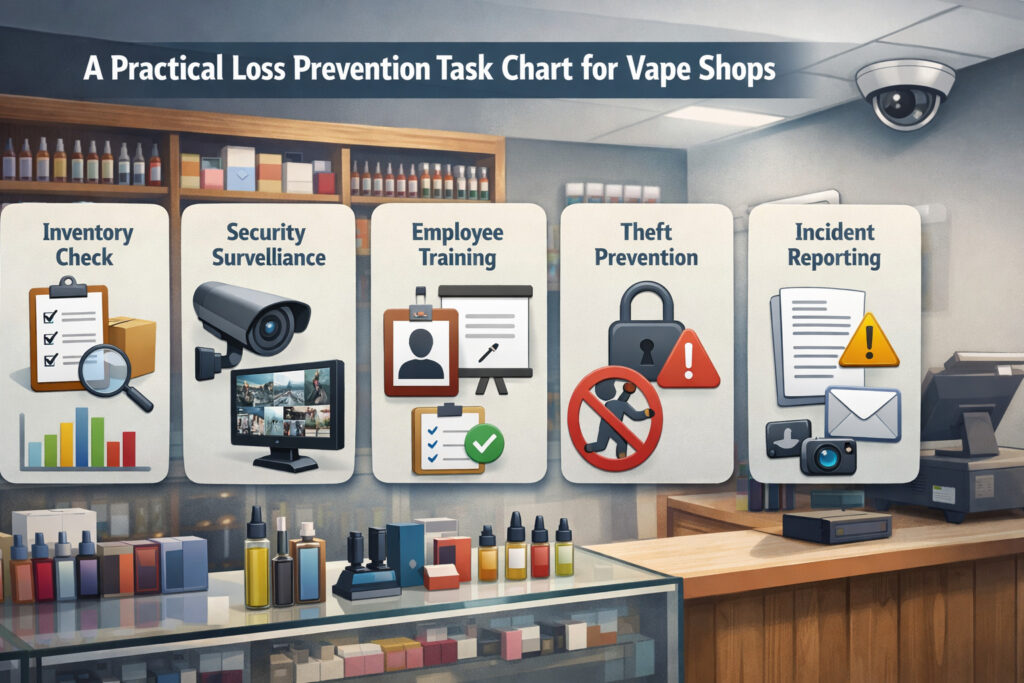
Before getting into the 10 best ways to prevent internal theft in a vape shop, it helps to see how strong controls work over time. Loss prevention should not be an occasional reaction. It should be a steady operating rhythm.
| Task | Daily | Weekly | Monthly | Why It Matters |
| Blind cash counts by shift | Yes | Reduces drawer manipulation and increases cashier accountability | ||
| Review voids, refunds, discounts, and no-sales | Yes | Helps spot unusual transaction behavior early | ||
| Cycle count high-risk SKUs | Yes | Yes | Catches inventory shrink before it becomes a large loss | |
| Check surveillance coverage and camera function | Yes | Prevents blind spots and makes video useful when needed | ||
| Reconcile received inventory to purchase records | Yes | Reduces receiving theft and stock entry errors | ||
| Review exception reporting by employee | Yes | Highlights suspicious patterns tied to specific users | ||
| Audit user permissions and access levels | Yes | Limits unnecessary system access | ||
| Refresh theft and policy training | Yes | Reinforces expectations and procedures | ||
| Review opening, closing, and handoff compliance | Yes | Tightens process gaps where shrink often occurs | ||
| Investigate unresolved variances | Yes | Prevents recurring issues from becoming normalized |
1. Hire Carefully and Verify References
One of the best ways to prevent internal theft in vape shop operations is to reduce avoidable hiring risk before a new employee ever touches your register or back room. Not every theft problem starts with a bad hire, but rushed hiring often leads retailers to overlook red flags that later become expensive.
In a busy store, it is tempting to hire based on availability, product knowledge, or personality alone. Those qualities matter, but so do reliability, integrity, and consistency. Someone can be friendly with customers and still be careless or dishonest behind the counter. A stronger hiring process does not need to be complicated. It just needs to be consistent.
Start with an application process that asks for complete work history, not just recent positions. Look for unexplained gaps, vague job descriptions, or a pattern of short stays in cash-handling roles.
During interviews, ask direct scenario-based questions about handling mistakes, discount requests from friends, returns without receipts, and end-of-shift shortages. People reveal a lot when asked how they respond to uncomfortable retail situations.
Reference checks matter more than many retailers think. Even a brief conversation can tell you whether a former employer would rehire the person, whether attendance was reliable, and whether the employee handled money responsibly. This is a basic but underrated part of employee theft prevention retail planning.
Build a Hiring Process That Screens for Judgment, Not Just Personality
Many owners unintentionally hire for likability and speed instead of judgment. In a vape retail setting, judgment matters every day. Employees handle restricted product inventory controls, deal with customer pressure, access stock rooms, process refunds, and make small decisions that affect loss exposure.
Ask questions that show how a candidate thinks. For example, what would they do if a friend asked for an unauthorized discount? How would they handle finding an extra bottle of e-liquid in a shipment that was not on the packing slip? What would they do if a coworker told them to skip a count because the store was busy? The goal is not to catch perfect answers. It is to see whether the candidate naturally leans toward accountability.
It is also wise to set expectations early. Explain that your shop uses access control, blind cash counts, SKU-level tracking, surveillance best practices, and transaction review. Honest applicants usually appreciate structure. People who seem overly defensive about routine oversight may be showing you something worth noticing.
2. Limit POS Permissions by Role
Too many vape shops give every cashier broad POS access because it feels easier. That convenience often creates preventable risk. If every employee can issue refunds, override prices, open the drawer, edit tax settings, delete line items, and change product data, you are relying almost entirely on trust instead of control.
Role-based POS permissions are one of the strongest vape shop loss prevention strategies because they reduce opportunity. A cashier should be able to complete normal sales, but not necessarily process manager-level functions without approval.
A shift lead may need more access than a new hire, but still not full administrative control. Limiting permissions supports employee accountability by making it harder to hide theft inside everyday transactions.
This matters even more when your store carries fast-moving, high-shrink items. An employee with wide-open permissions can under-ring a premium disposable as a lower-cost item, apply hidden discounts, or use refund functions to remove products after taking payment. Without a clean retail audit trail, those actions may blend in with normal sales activity.
If you are reviewing your system setup, it can also help to look at broader operational guidance around POS structure and workflows, such as this resource on how a POS system simplifies vape store management. Strong permissions are part of making the register a control point, not just a checkout tool.
Match System Access to Actual Job Duties
The simplest rule is this: if an employee does not need a function to do the job well, they should not have access to it. That applies to refunds, voids, discount creation, manual price overrides, no-sale drawer opens, product editing, inventory adjustments, and report access.
Start by creating clear roles such as cashier, senior associate, keyholder, manager, and owner. Then decide exactly what each role can and cannot do. A cashier may be allowed to scan products, complete sales, and call for approval when needed.
A manager may be the only role permitted to approve high-value returns, tax-exempt changes, or large discounts. That structure supports vape shop internal loss control without slowing the entire store.
You should also remove shared logins immediately. Shared credentials destroy accountability. Every transaction must tie back to an individual user so exception reporting can actually mean something.
Require unique passwords, regular password changes, and automatic logout after inactivity. If employees share access, it becomes far harder to identify the person behind suspicious behavior.
3. Track Inventory Frequently, Especially High-Risk SKUs
Inventory theft prevention vape shops need starts with frequency. Annual counts are not enough. Even monthly counts may be too slow for stores that sell lots of small, valuable products.
When shrink is discovered late, it becomes much harder to identify where it happened, who had access, and whether the issue was theft, receiving error, or poor count discipline.
High-risk products in a vape shop usually include disposables, pods, coils, batteries, e-liquids, replacement cartridges, chargers, and compact premium accessories. These items are easy to conceal, easy to miscount, and often sold in enough volume that a few missing units may not trigger alarm right away. That is exactly why cycle counting matters.
Instead of waiting for a full-store inventory day, count selected categories throughout the week. One day might focus on disposables, another on pods, another on bottled e-liquids by brand or nicotine strength.
Frequent SKU-level tracking helps you spot loss trends while the trail is still warm. It also improves purchasing decisions and reduces the odds that you will reorder missing stock by mistake.
For owners comparing systems or planning upgrades, it is also worth understanding how infrastructure affects stock visibility and reporting, especially in multi-shift or multi-location setups. This guide on cloud vs. local POS systems for vape retailers is a useful background when evaluating how often your team can access real-time counts and audit history.
Use Cycle Counts and Stock Reconciliation to Find Problems Early
Strong stock reconciliation depends on structure, not guesswork. Set a schedule for counting high-risk SKUs and stick to it. Do not only count when something feels off. Reactive counting invites blind spots.
A good approach is to compare physical counts against system counts in small, manageable groups. When a variance appears, do not simply adjust the number and move on. Investigate what may have caused it.
Check recent receiving records, transfers, returns, damaged product logs, and sales history. This is where vape shop internal loss control becomes real. You are not just correcting counts. You are building a habit of asking why.
It is also smart to separate counting responsibility from the person who primarily stocks or sells those items when possible. Even in a small team, rotating count assignments helps reduce opportunity and strengthen accuracy. If one person always receives, shelves, and counts the same category, the control is weaker.
4. Enforce Strict Cash Handling Procedures
Cash still creates major internal theft risk because it can disappear without leaving the same digital record as card transactions. In many shops, the biggest cash problems do not come from one huge theft. They come from repeated small shortages, poorly documented payouts, open drawers, and inconsistent shift procedures.
Strong cash handling controls make theft harder and mistakes easier to identify. Every drawer should belong to a specific employee or clearly defined shift. Starting amounts should be verified.
Mid-shift loans between drawers should not happen. No one should be making change from another till “just this once.” Those habits create confusion and destroy accountability.
Blind cash counts are one of the most effective controls. When employees count down a drawer without knowing what the system expects, you get a more honest picture of what is actually there. If staff already know the expected total, some will unconsciously count toward the target instead of the real amount. Others may use that knowledge to hide shortages.
Cash procedures also need structure around drops, safe access, paid-outs, and drawer removal. If your store regularly handles strong cash volume, document who can access the safe, when drops occur, and how they are recorded. Employee theft prevention for smoke shops often fails because cash processes are treated as routine rather than controlled.
Make Every Shift Financially Accountable
The goal is simple: each shift should leave a clean trail. Assign drawers to individuals when possible. If the store must share a drawer, use tightly defined handoff times with signed documentation.
Count the drawer at the start and end of each shift, record paid-ins and paid-outs clearly, and require manager approval for unusual activity.
Handoffs deserve special attention. A lot of shrinkage starts in the gaps between people. If one employee leaves and another takes over without a verified count, both can later deny responsibility for shortages.
A handoff should include a quick drawer check, signature or digital acknowledgment, and confirmation that the till is correct before responsibility changes.
It is also smart to monitor no-sales, manual drawer opens, and cash transactions that do not line up with sales volume. These patterns often point to cash leakage. Exception reporting on drawer discrepancies can be especially helpful when paired with surveillance and time-stamped POS records.
5. Review Refunds, Voids, Discounts, No-Sales, and Manual Price Overrides Regularly
Not all internal theft looks like stolen product or missing cash from a drawer. Some of the most damaging losses happen inside normal-looking transactions. Refund abuse, post-sale voids, fake returns, excessive discounts, no-sale opens, and manual price changes are classic examples.
This is where a lot of stores fall behind. Owners glance at sales totals but do not review transaction behavior in detail. That leaves a major blind spot. A cashier may issue refunds to a personal card, cancel line items after taking cash, or overuse discounts for friends. Because the activity appears in the POS, it can look legitimate unless someone reviews the context.
Void and refund monitoring should be part of daily or weekly management, not a once-in-a-while audit. Look at who processed the transaction, when it happened, what items were involved, whether a manager approved it, and whether the behavior is consistent with the rest of the team.
A cashier whose refund rate is three times higher than everyone else deserves a closer look, even if every transaction has a note.
Discounts also need attention. Unauthorized markdowns on disposables, pods, or premium devices can quietly drain margin. So can frequent manual price overrides on products that should scan at a fixed amount. These are essential retail shrink prevention vape store controls because they address theft hidden inside the register.
Focus on Exceptions, Not Just Totals
Managers often get overwhelmed by reports because there is too much data. The answer is not to stop reviewing.
It is to focus on exception reporting. Instead of staring at every transaction, look for outliers such as unusually high void rates, repeated end-of-shift refunds, frequent manual overrides, large employee discounts, or discount patterns tied to certain customers.
That approach saves time and improves accuracy. If one associate consistently uses no-sales more than the rest of the team, ask why. If an employee’s discounts cluster around the same days, same items, or same hours, compare that with camera footage and customer flow. If voids happen right after cash transactions, investigate whether items were removed after payment.
A modern system can help here, but process still matters. Review exceptions on a schedule. Document what you checked. Follow up when something looks off. Small stores sometimes assume this level of oversight is only for large retailers, but in reality small teams benefit the most because one problem employee can have a bigger impact.
6. Use Surveillance and Visible Deterrents Wisely
Cameras matter, but not because they magically stop theft. They work best when they support good processes. Surveillance best practices help you verify events, investigate suspicious patterns, and remind employees that the store takes accountability seriously. What cameras cannot do is replace counting, training, permissions, and review.
A vape shop should have coverage at the register, entrances, stock room, high-shrink displays, receiving area, and cash handling points.
Placement matters. If the camera sees the employee but not the drawer, or shows the counter but not the products being bagged, its usefulness drops fast. Audio rules vary by location, so follow applicable requirements and focus first on clear visual coverage.
Visible deterrents also help. Mirrors, sightlines, organized merchandising, and clear employee-only zones support vape store security solutions without making the environment feel hostile.
In many cases, a tidy layout with fewer blind spots reduces both internal and external loss. Back rooms should not feel like unmonitored free space where products can disappear unnoticed.
The key is balance. Employees should know cameras exist and why. Honest staff usually welcome professional oversight when it is explained as part of store protection and fair accountability.
Design Coverage Around Risk Points, Not Just General Visibility
Too many stores place cameras where they are easiest to mount rather than where loss actually happens. Start with your risk points.
Can you clearly see void and refund activity at the register? Can you verify cash drops? Can you observe receiving and stock movement from the delivery area into the back room? Can you confirm who accessed high-risk product storage?
This is where good surveillance becomes a tool for vape shop internal loss control. When exception reporting shows an unusual refund or inventory count reveals shrink in a certain category, time-stamped footage helps you narrow the window. That makes investigations faster and fairer.
Visible signage and employee awareness also matter. You do not need aggressive warnings everywhere, but it helps to communicate that transaction activity, stock movement, and critical store areas are monitored. Most people are less likely to test weak behavior boundaries when they know oversight is real and consistent.
7. Separate Duties Where Possible
One of the biggest internal control mistakes in small retail operations is allowing one person to control an entire process from start to finish. When the same employee can receive inventory, enter it into the system, stock it, count it, sell it, and adjust it later, the opportunity for hidden loss increases sharply.
Separating duties does not mean you need a large staff. It simply means you should avoid concentrating too much control in one set of hands when a practical alternative exists. Even in a small vape shop, you can create basic checks and balances.
One person can receive products while another confirms quantities. One employee can count drawers while a manager reviews. A cashier can request a refund, but a supervisor approves it.
This principle helps reduce internal theft in retail stores because it limits the chance that one person can both commit and conceal theft. It also reduces accidental errors. If receiving is rushed and the same person later counts the stock, they may repeat the original mistake without realizing it. A second set of eyes often catches issues before they shrink.
Separation of duties also strengthens your retail audit trail. When records show who received, who approved, who adjusted, and who counted, your investigations become more factual and less emotional.
Use Small-Team Workarounds When Staffing Is Tight
Many independent vape retailers assume this control is impossible with a lean team. It is harder, but not impossible. The answer is to build rotation and review into routine tasks.
For example, if one employee receives a product during a morning delivery, a manager or second employee can verify selected counts later the same day. If only one person closes, an opening manager can review the prior close against system and camera records.
Even simple workarounds help. Rotate who performs cycle counts. Require manager review for manual inventory adjustments. Have owners spot-check high-risk products after delivery days. Separate physical key access from system permissions where possible. The point is not perfection. The point is reducing unobserved control.
This is one of the most overlooked vape shop loss prevention strategies because it sounds operational rather than security-focused. In reality, it is one of the strongest process-based controls available to smaller stores.
8. Create Written Policies and Train Consistently
Many vape retailers assume employees already understand what counts as theft, policy abuse, or unacceptable shortcuts. That assumption creates risk.
If expectations live only in the owner’s head or get explained differently by different managers, enforcement becomes inconsistent. Inconsistent enforcement weakens accountability and gives dishonest employees room to claim confusion.
Written policies are a key part of employee theft prevention for smoke shops because they define the rules before a problem happens.
Your policy should cover cash handling controls, discounts, employee purchases, voids and refunds, no-sales, inventory movement, damaged items, bag checks if used, safe access, personal belongings in work areas, product holds, and reporting suspicious behavior. It should also explain that transaction activity and stock movement are reviewed.
Training matters just as much as the written document. New hires should receive policy training during onboarding, but that is not enough. Staff need refreshers, especially after procedure changes, new system tools, or repeated store issues. Good training reduces both intentional abuse and honest mistakes.
Policies should also explain why controls exist. Employees are more likely to follow procedures when they understand that loose handling affects inventory accuracy, store profitability, compliance, and fairness to the rest of the team.
Turn Policy Into Daily Habit, Not a Binder on a Shelf
A written policy is useless if nobody remembers it. The best stores turn policy into daily behavior through short reminders, coaching, and consistent manager follow-through. Mention till rules during shift changes.
Review return procedures during team meetings. Revisit stock reconciliation after a receiving issue. Policy should feel active, not forgotten.
It also helps to use examples relevant to vape retail. Explain that disposables cannot be “held aside” without documentation. Clarify that employee purchases must go through the same process as customer sales. Define how damaged e-liquid, open-box hardware, and expired stock must be recorded. Specific examples reduce gray areas.
Consistency is essential. If one employee gets corrected for an unauthorized discount while another is ignored for the same thing, your standard collapses. Strong policy enforcement does not mean harshness. It means fairness and predictability. That is how you build employee accountability without creating a toxic atmosphere.
9. Use Reports and Exception Alerts to Spot Patterns
Data becomes powerful when it helps you see behavior patterns that human observation misses. Most internal theft is not caught because someone happens to witness the act. It is caught because a report reveals something unusual. That is why exception reporting is one of the most effective vape store security solutions available.
Review employee-level data on refunds, voids, discounts, no-sales, manual price overrides, inventory adjustments, drawer discrepancies, and after-hours activity. Look for people who consistently sit outside team averages. One odd transaction may mean nothing. Repeated outlier behavior usually means something needs attention.
This kind of review is especially useful in stores with multiple employees sharing the same physical space. Managers cannot watch every interaction. Reports help narrow where to look. They also make investigations more objective.
Instead of accusing someone based on a feeling, you can say that a pattern requires review because the data does not match normal operating behavior.
If you are evaluating systems or budgeting for better visibility, it helps to understand how reporting and control features affect long-term value. This overview on the costs of vape shop POS systems is useful for thinking about whether a cheaper setup may actually cost more in shrink and manual oversight.
Watch for Behavioral Patterns, Not Just Single Incidents
The most useful reports tell a story over time. An employee who has high voids only during certain shifts, repeated discount use for the same product class, or frequent drawer shortages that stay just under the level that triggers attention may be exploiting your thresholds. One transaction rarely proves much. Repetition does.
You should also compare reports across categories. For example, if a cashier has frequent no-sales and also a higher-than-average cash shortage rate, that combination matters.
If a staff member processes unusual refunds and cycle counts show missing pods or disposables during their shifts, that deserves prompt review. Good retail shrink prevention vape store programs connect signals instead of looking at reports in isolation.
Set alert thresholds where possible. Large discounts, repeated manual overrides, negative inventory adjustments, and after-hours logins should trigger review quickly. Alerts do not replace management judgment, but they make sure unusual activity does not sit buried for weeks.
10. Investigate Issues Quickly and Fairly
When something looks wrong, speed matters. The longer you wait, the harder it becomes to verify what happened, gather records, review footage, and separate fact from rumor. At the same time, investigations should be calm, professional, and fair. Jumping to conclusions can damage trust and expose you to unnecessary risk.
Start with facts. Identify the transaction, time window, inventory variance, or report pattern that triggered concern. Pull the retail audit trail, review related approvals, and check surveillance if available.
Compare that information with schedules, receiving logs, stock counts, and drawer records. The goal is to understand what happened, not simply to confirm suspicion.
Avoid discussing the issue casually with the team. Internal theft concerns should be handled discreetly. Gossip spreads fast, and it damages morale even when nothing improper is proven. If you need to speak with an employee, keep the conversation focused on observable facts and store procedures. Ask questions. Listen carefully. Document the discussion.
This approach is essential for vape shop internal loss control because some suspicious patterns are caused by training gaps or bad process, not theft. A rushed manager might mistake poor procedure for dishonesty, or vice versa. Fair review protects the business either way.
Build a Consistent Investigation Process
A good investigation process usually follows the same basic sequence: identify the issue, secure the records, review the data, check relevant video, compare related activity, interview only necessary people, document findings, and decide on next steps. That consistency helps you stay objective.
If theft appears likely, follow your existing employment and legal procedures carefully. If the issue turns out to be poor training or weak controls, fix the root problem immediately. Many stores make the mistake of treating each variance as a one-time incident instead of asking what system weakness allowed it.
It is also wise to keep clear documentation. If you later discover repeated issues tied to the same employee or process, earlier notes become important. Documented patterns support better decisions than memory alone.
Common Warning Signs of Internal Theft
Warning signs do not prove theft on their own, but they help managers know where to look. The strongest approach is to treat these signs as triggers for review, not automatic guilt.
Internal Theft Warning Sign Checklist
- Repeated drawer discrepancies tied to the same employee or shift
- Frequent no-sales or manual drawer opens without clear explanation
- Higher-than-average voids, refunds, or discounts by one user
- Manual price overrides on products that should scan normally
- Inventory shrink concentrated in small, high-value categories
- Unexplained stock variances after certain employees receive or stock product
- Employees resisting blind cash counts or cycle counts
- Staff spending unusual time alone in stock rooms or back areas
- Missing damaged product documentation
- Customers reporting that they paid more or less than expected
- Employees pressuring others to skip procedures “because it’s busy”
- Returns processed without consistent supporting details
- Shared logins, missing approval records, or vague transaction notes
- Repeated friendliness with customers that coincides with unauthorized discounts
- Staff who seem overly interested in where cameras do and do not point
How to Respond Without Creating Panic
The right response to warning signs is structured review. Pull reports. Check the audit trail. Count relevant stock. Review footage. Compare behavior across the team. You want to identify patterns, not spread suspicion.
Managers should also be careful not to let frustration drive the process. If you overreact publicly to one red flag, honest employees may become nervous while the actual problem remains hidden. Calm, evidence-based follow-up is far more effective. Good employee theft prevention retail programs protect trust by investigating privately and acting consistently.
Common Mistakes That Increase Shrink Risk in Vape Shops
Sometimes theft risk grows because of habits the store has normalized. Owners often focus on catching bad behavior without fixing the operating mistakes that make it easier.
One common mistake is trusting long-term employees without maintaining controls. Experience and loyalty matter, but no one should be above process. Another is giving everyone full system access because it is more convenient. Weak access control invites abuse and makes exception reporting less useful.
Infrequent counting is another major issue. If high-risk items go unchecked for weeks, losses can pile up fast. So can sloppy cash habits such as shared drawers, predictable drawer totals, unrecorded payouts, and handoffs without verification. These are classic causes of shrink in stores that otherwise feel “well run.”
Another mistake is overrelying on cameras while ignoring daily review. Surveillance helps after the fact, but it rarely replaces stock reconciliation, blind cash counts, role-based permissions, or written policy. And finally, many stores fail to train consistently. Procedures get explained one way by one manager and differently by another, leaving plenty of gray area.
Process Beats Guesswork Every Time
The strongest vape shop loss prevention strategies are usually not dramatic. They are repetitive. Count, review, reconcile, approve, document, and train. That routine is what protects a store over time.
This is also why process-based vape store security solutions often produce better results than buying more hardware alone. Better cameras can help. Better locks can help. But if your team can still adjust inventory freely, share logins, skip handoffs, and process refunds without oversight, shrink will keep finding a way in.
How to Build a Culture of Accountability Without Hurting Morale
One fear many owners have is that stronger controls will make the team feel distrusted. That can happen if loss prevention is introduced in a reactive, accusatory way. It does not have to happen that way.
The healthiest approach is to frame controls as professional standards that protect everyone. Honest employees benefit when policies are clear, drawers are assigned properly, stock is tracked accurately, and transaction approvals are consistent. These systems prevent false blame, reduce confusion, and make expectations fair.
Managers should communicate that controls are store-wide, not personal. Everyone follows them. Everyone is accountable. Everyone benefits from cleaner operations, fewer mistakes, and better inventory accuracy.
That message matters. When controls are presented as punishment, morale drops. When they are presented as standard operating practice, the team usually adapts well.
Recognition also helps. Praise employees who follow procedures carefully, catch receiving errors, report discrepancies, or keep accurate drawers. Accountability should not only appear when something goes wrong. Positive reinforcement makes the culture feel balanced rather than suspicious.
Lead With Consistency and Respect
Culture is built by what managers tolerate and repeat. If leaders ignore policy when it is inconvenient, employees will do the same. If managers follow the same rules they expect from the team, accountability feels legitimate.
Respect matters too. Ask for counts professionally. Correct errors calmly. Handle investigations privately. Keep coaching specific and factual. People are more likely to buy into strong controls when they feel they are working in a professional environment instead of a blame-heavy one.
When stores succeed at this balance, they do more than reduce internal theft in retail stores. They build a team that understands why procedures matter and takes pride in running a tight operation.
Frequently Asked Questions
What is the most common form of internal theft in a vape shop?
The most common form of internal theft is usually not obvious product stealing. It often shows up as small, repeated losses hidden inside normal activity, such as unauthorized discounts, under-ringing products, fake refunds, missing cash from poorly controlled drawers, and inventory shrink involving disposables, pods, coils, and bottled e-liquids.
How often should a vape shop count inventory to reduce employee theft?
High-risk categories should be counted much more often than full-store inventories. A practical approach is to count small, high-value SKUs daily or several times per week, while rotating broader cycle counts throughout the month. Frequent stock reconciliation helps catch shrink early and makes internal theft easier to detect.
Are cameras enough to prevent internal theft in a vape shop?
No. Cameras are helpful, but they are only one part of a strong loss prevention plan. Surveillance supports investigations and discourages some bad behavior, but it cannot replace role-based POS permissions, blind cash counts, transaction reviews, written policies, inventory tracking, and manager oversight.
What reports should vape shop owners review first if they suspect employee theft?
Owners should start by reviewing employee-level reports for refunds, voids, discounts, no-sales, manual price overrides, negative inventory adjustments, and drawer discrepancies. Comparing those reports with schedules, stock variances, and video timestamps can help identify unusual patterns and narrow down where further review is needed.
How can a small vape shop prevent internal theft with only a few employees?
Small vape shops can still reduce internal theft by using individual logins, limiting POS permissions by role, requiring blind till counts, documenting shift handoffs, counting high-risk inventory frequently, and requiring manager approval for refunds and larger discounts. Even with a small team, consistent review and strong daily procedures can lower shrink significantly.
Should employees be told that transactions and inventory are being reviewed?
Yes. Employees should know that the store uses standard oversight such as inventory checks, audit trails, cash handling controls, and transaction reviews. Clear communication helps create a professional environment, supports employee accountability, and reduces the chance that staff see loss prevention controls as personal mistrust.
What should a vape shop do if theft is suspected but not yet proven?
The best response is to stay calm and work from facts. Review the transaction history, inventory records, schedules, approvals, and surveillance tied to the issue. Avoid public accusations, limit discussion to necessary people, and document the findings carefully. Some patterns point to poor training or process gaps rather than theft, so a fair and structured review is essential.
Can better systems and POS controls really help reduce internal theft?
Yes. Better systems can make a major difference because they reduce opportunity and improve visibility. Features like role-based access, audit trails, exception reporting, SKU-level tracking, and manager approval workflows help vape retailers detect suspicious behavior earlier and build stronger day-to-day internal loss control.
Conclusion
Internal theft is difficult because it often looks small until it becomes expensive. In a vape retail setting, where products are compact, margins matter, and transaction control is critical, even minor weaknesses in process can create steady loss over time.
Missing disposables, unexplained refunds, drawer discrepancies, and inconsistent counts are not just annoyances. They are warning signs that your controls need work.
The most reliable way to prevent internal theft in vape shop operations is to combine people, process, and system discipline. Hire carefully. Limit POS permissions. Count high-risk SKUs often.
Enforce strict cash handling procedures. Review refunds, voids, discounts, no-sales, and price overrides. Use surveillance strategically. Separate duties when possible. Train against written policy. Review exception reports. Investigate fairly and quickly.
Most important, build a culture where accountability is normal, not personal. Honest employees want clear rules and consistent standards. When your store runs with strong controls, you do more than reduce shrink. You protect profit, improve accuracy, strengthen compliance, and create a healthier operation for everyone involved.